
Black Tea Brewing Methods and Variables
A reliable starting point for most black tea brewing methods is simple: use fresh-tasting water, heat it close to boiling for a robust black tea, use enough tea for the cup size, steep for about 3–5 minutes, then remove the leaves or bag and taste before adding milk, lemon, sugar, or ice.
That is a starting point, not a law. Black tea changes quickly when you adjust steeping time, water temperature, tea-to-water ratio, leaf form, vessel, water, and additions. A cup that tastes thin may need more leaf rather than more time. A cup that tastes bitter or drying may need a shorter steep, slightly cooler water, less leaf, or a different leaf form. The useful skill is not memorizing one perfect recipe; it is learning which variable changes which result in the cup.
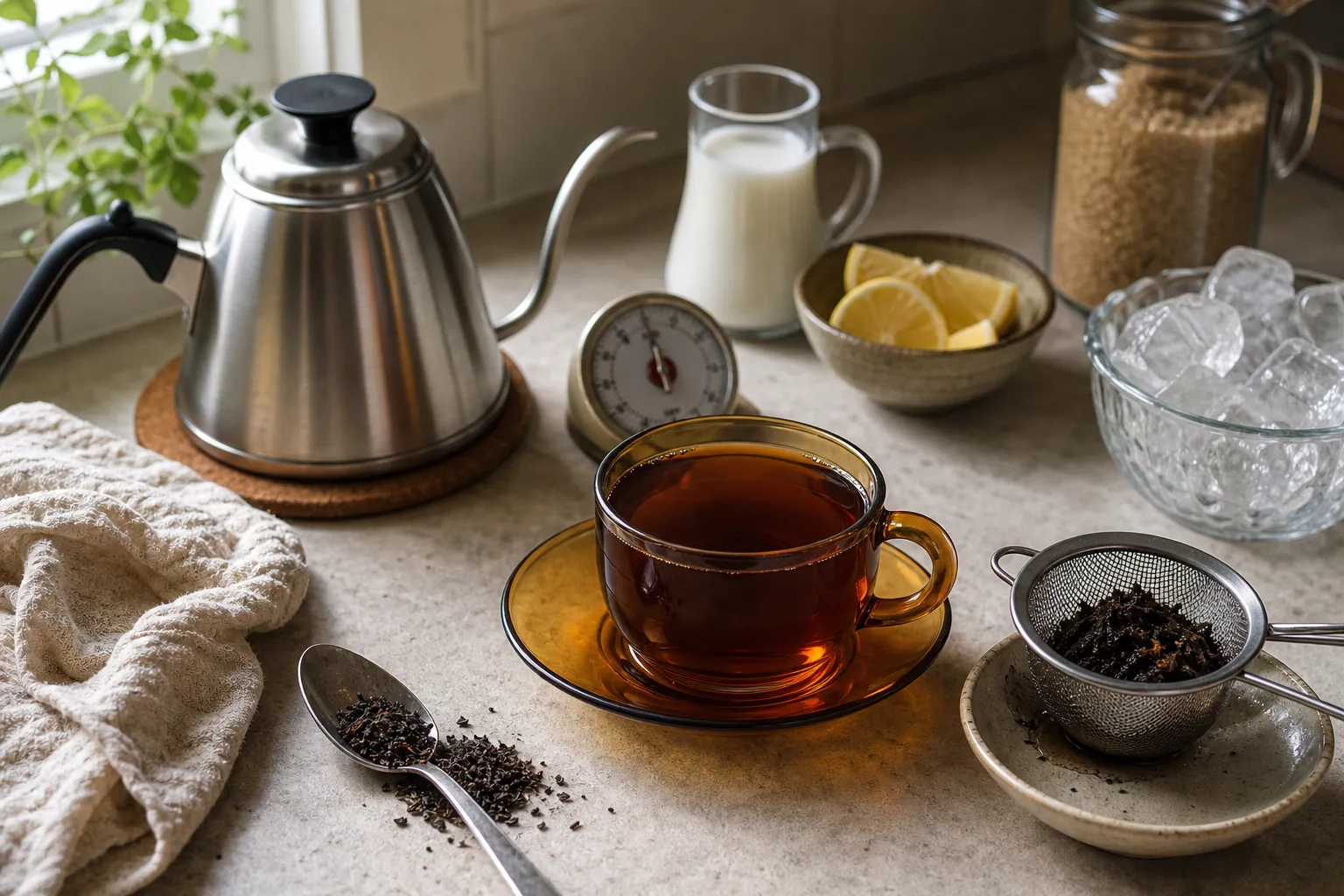
A Practical First Cup of Black Tea
For a plain hot cup, begin with a moderate recipe and adjust from what you taste.
A good first brew
- Use fresh-tasting water. If your water smells strongly of chlorine, metal, or minerals, the cup may taste flat or rough before the tea has a chance to show itself.
- Use enough tea. A common home baseline is about 1 teaspoon of loose black tea for an 8-ounce cup, or one standard tea bag for a mug. Larger mugs need more tea.
- Heat the water close to boiling for sturdy black teas. Breakfast blends, many CTC teas, Assam-style teas, and everyday black teas are often brewed this way.
- Steep around 3–5 minutes. Start closer to 3 minutes for small particles, tea bags, delicate black teas, or bitterness-sensitive palates; go longer for larger leaves, milk-friendly blends, or a fuller body.
- Remove the tea. Leaving the leaves or bag in the cup turns the recipe into an uncontrolled long steep.
- Taste first. Add milk, lemon, sugar, honey, spices, or ice after you know what the brewed tea is doing.
This baseline works because many black teas are processed to produce stronger color, body, briskness, and aroma than lighter tea styles. But black tea is not one thing. A bright Darjeeling-style black tea, a strong breakfast blend, a smoky black tea, a broken-leaf tea bag, and a large-leaf Chinese black tea can all respond differently to the same water and time.
The rest of this page gives you a framework for adjusting the cup without turning brewing into a rigid ceremony.
What You Are Controlling in the Cup
Black tea brewing is not only about “strong” versus “weak.” Several cup-level traits move together, but not always in the same direction.
Aroma
Malt, honey, citrus, floral notes, dried fruit, smoke, spice, earth, toast
Freshness, water, temperature, vessel heat, leaf quality, steeping time
Liquor color
Amber, copper, red-brown, dark brown
Leaf form, oxidation, tea amount, time, temperature, water minerals
Strength
How concentrated the cup feels
Tea-to-water ratio, leaf particle size, time, water volume
Briskness
Lively, bright, palate-clearing snap
Tea style, extraction level, water, time, milk pairing
Body
Weight and roundness in the mouth
Leaf amount, processing style, soluble material, milk, water composition
Bitterness
Sharp bitter taste on the tongue
Oversteeping, high extraction, too much leaf, small particles, some tea styles
Astringency
Drying or gripping sensation on gums and cheeks
Polyphenol extraction, long steeping, high ratio, broken particles, some black tea styles
Aftertaste
Lingering sweetness, dryness, malt, smoke, citrus, or roughness
Tea style, extraction balance, additions, water, freshness
A dark cup is not automatically balanced. A pale cup is not automatically weak. A strong cup can still be smooth, and a light cup can still be aromatic. The best adjustment depends on what is missing or excessive.
The Main Black Tea Brewing Variables
The most useful way to understand black tea brewing is to treat it as a set of connected controls. Change one variable at a time when possible. If you change the tea amount, steeping time, water temperature, and vessel all at once, it becomes hard to know what improved the cup.
Steeping Time
Black tea steeping time shapes strength, color, aroma, bitterness, and astringency. Longer contact with hot water generally extracts more from the leaf. That can be desirable when the cup is thin, but it can also push the tea into harshness.
For many hot black teas, 3–5 minutes is a practical starting range:
- 2–3 minutes: Useful for small particles, quick-brewing tea bags, delicate black teas, or teas that turn bitter fast.
- 3–4 minutes: A balanced starting point for many loose black teas and everyday mugs.
- 4–5 minutes: Often useful for robust breakfast-style blends, larger leaves, or tea intended for milk.
- Beyond 5 minutes: Sometimes intentional, but more likely to increase bitterness and drying astringency unless the tea suits it.
If you want more strength, do not automatically steep longer. First ask whether the cup needs more concentration or more extraction. More concentration usually comes from increasing the tea-to-water ratio. More extraction comes from time and temperature. They are related, but they are not the same.
Water Temperature
Near-boiling water for black tea is common, especially for robust blends, CTC teas, breakfast teas, and milk-friendly cups. High heat can help draw out color, body, briskness, and aroma. But “black tea” covers a wide range, and some teas become bitter, woody, or sharp when brewed with fully boiling water and a long steep.
Strong breakfast blend, CTC tea, milk tea base
Near boiling is often appropriate.
Large-leaf black tea with malt, cocoa, honey, or fruit notes
Near boiling or slightly below, adjusted by taste.
Delicate, high-grown, or floral black tea
Try slightly cooler water if the cup tastes harsh.
Small particles or tea bags
Shorter time may matter as much as temperature.
Bitter cup despite a short steep
Lower the temperature and retest.
You do not need a precision kettle to brew black tea well. If you do not measure temperature, work by timing after the boil: pour immediately for a sturdy tea, or let the water rest briefly before pouring for a more delicate one. Repeatability matters more than theatrical precision.
Tea-to-Water Ratio
The black tea to water ratio controls concentration. It is the variable most likely to fix a weak cup without creating an oversteeped cup.
A large mug brewed with the same tea amount as a small cup will taste diluted. A tea bag in a 16-ounce mug may seem “bad” when the real issue is water volume. Likewise, a small teapot needs enough leaf for the total amount of water, not just one casual spoonful.
A useful starting point
- Standard mug: 1 tea bag or about 1 teaspoon loose black tea for 8 ounces of water.
- Large mug: Increase the tea amount or accept a lighter cup.
- Small teapot: Count the total water volume and scale the tea.
- Milk tea or iced tea: Brew stronger than you would for a plain hot cup, because milk and ice soften or dilute perceived strength.
If a cup is weak, try increasing the leaf by 25–50% before extending the steep by several minutes. This often gives more body and aroma with less bitterness than simply leaving the tea in longer.
Leaf Form
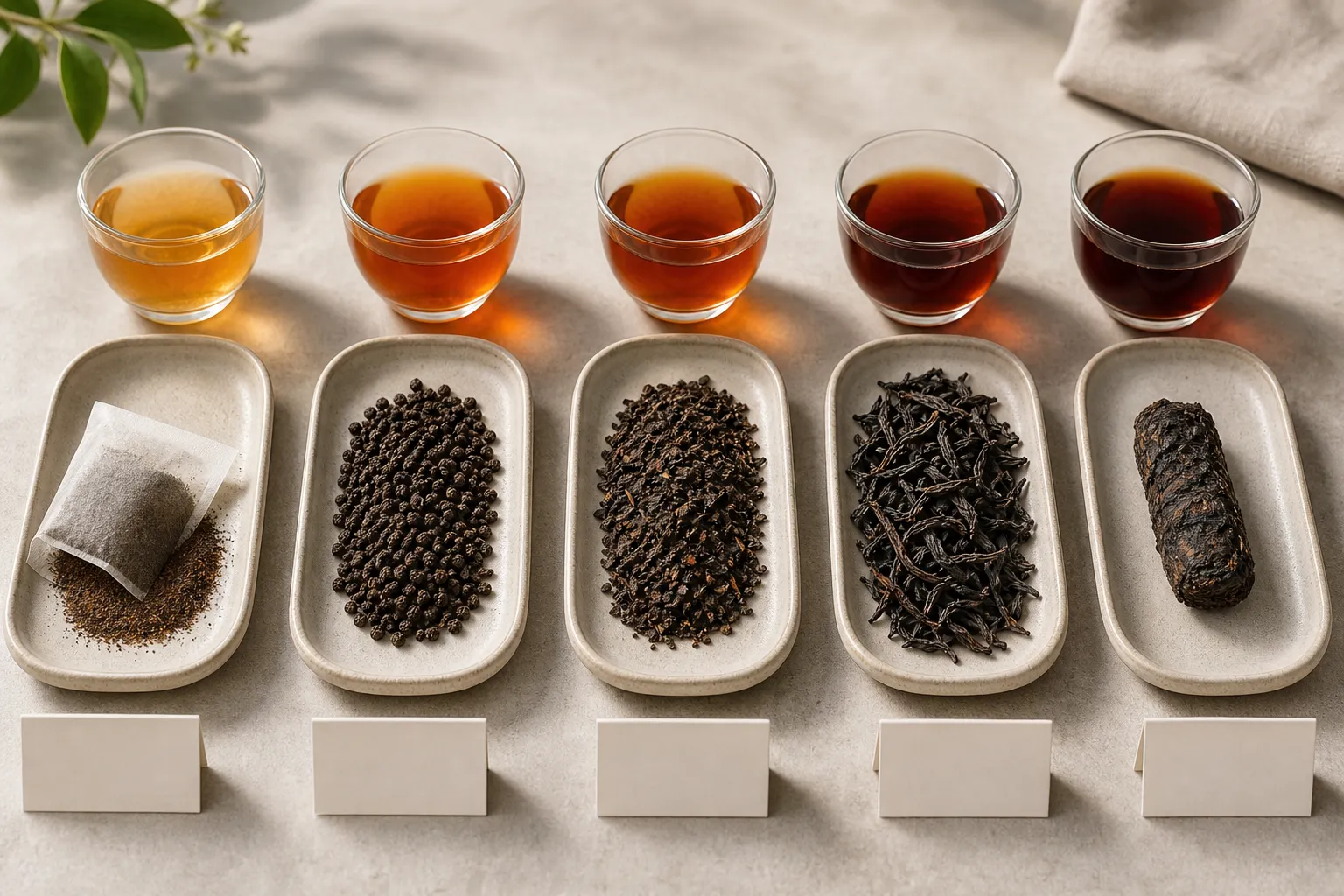
Leaf form changes how quickly tea infuses. Smaller particles expose more surface area to water, so they often brew faster and darker than larger whole or rolled leaves. This is one reason many tea bags produce a strong cup quickly.
CTC means cut, tear, curl. It describes a manufacturing process that produces small, granular tea particles. CTC black tea is common in strong breakfast-style blends and milk-friendly teas. It should not be dismissed as inherently poor; it is designed for speed, color, and strength.
Whole leaf or larger loose leaf often gives the drinker more room to control aroma, texture, and infusion pace. Larger leaves may need enough space to unfurl and enough time to release flavor. But loose leaf is not automatically superior in every context. A good tea bag can be more satisfying than stale or poorly brewed loose tea.
Fine tea bag particles
Quick color, fast strength, convenience, milk-friendly cups
Can oversteep quickly; may turn drying or bitter
CTC black tea
Strong liquor, briskness, body with milk
Needs ratio and time control
Broken loose leaf
Faster extraction than whole leaf, good everyday strength
Can become sharp if steeped too long
Whole or large loose leaf
Aroma, texture, more flexibility across methods
May taste weak if underleafed or cramped
Compressed or tightly rolled forms
Slow unfolding, changing infusions
May need more time or repeated infusions
The question is not simply loose leaf versus tea bags. Ask what cup you want: fast and strong, aromatic and layered, milk-ready, iced, delicate, or suited to repeated short infusions.
Vessel, Space, and Heat
A mug, teapot, gaiwan, small pot, basket infuser, filter bag, or strainer can all make good black tea. The vessel matters when it changes heat retention, leaf expansion, or your ability to stop the steep on time.
Ask four practical questions:
- Does the vessel hold enough heat for the steep?
- Do the leaves have room to expand?
- Can you separate the tea from the water at the chosen time?
- Can you repeat the same method if you like the result?
Preheating a mug or teapot with hot water can help maintain temperature, especially in a cold kitchen or with a large pot. A wide basket infuser usually gives loose leaves more room than a tiny ball infuser. A gaiwan or small pot makes short repeated infusions easier. None of this requires a gear collection; it is about controlling contact between leaf, water, and time.
Water
Water composition can influence tea flavor, color, and extraction. For everyday brewing, the practical lesson is modest: if your tea tastes dull, harsh, chalky, metallic, or unusually flat, water may be part of the problem.
Try a simple comparison before making strong conclusions
- Brew the same tea with your usual water.
- Brew it again with a neutral-tasting filtered or bottled water.
- Keep tea amount, vessel, temperature, and time the same.
- Compare aroma, color, bitterness, body, and aftertaste.
If the difference is obvious, adjust water. If it is not, focus on ratio and time first. Water matters, but it is rarely the first variable to perfect.
Western-Style Brewing and Gongfu Brewing
Two broad approaches explain many black tea brewing methods: Western-style brewing and gongfu-style brewing. They are not competing claims about correctness. They create different relationships between leaf, water, time, and attention.
Western-style black tea
Moderate tea amount, larger cup or pot, one main infusion lasting several minutes.
Best starting use: Full mug, teapot, breakfast tea, Earl Grey, tea bags, milk-friendly cups.
Gongfu brewing for black tea
More leaf, less water, short repeated infusions, small vessel.
Best starting use: Whole-leaf black tea, tasting sessions, aroma and texture exploration.
Western-style brewing is the everyday method behind many mugs of breakfast tea, afternoon tea, Earl Grey, and plain black tea. It is the best starting point if your question is simply how to brew black tea for a full cup or teapot. It is also the easiest method for comparing a new tea against package instructions.
Gongfu brewing for black tea uses more leaf, less water, shorter infusions, and repeated steeps. Instead of one large cup, you taste the tea across several small infusions. The method can show aroma changes, texture, sweetness, roast, fruit, malt, or dryness in a way that a single mug may blur. It is not necessary for every tea, and it is not automatically better. A tea that tastes excellent in a mug may not need a small-vessel session, while a fragrant whole-leaf black tea may become more expressive with repeated short infusions.
Choose by the cup you want
- Full mug with breakfast: Western-style brewing.
- Tea with milk or sugar: Western-style, often with a stronger ratio.
- Fast office cup: Tea bag or simple Western method.
- Comparing aroma changes: Gongfu-style brewing.
- Exploring whole-leaf black tea: Gongfu or careful Western brewing.
- Iced tea concentrate: Strong Western-style brew.
- Learning a new tea: Start Western, then try gongfu if the leaf seems aromatic or complex.
This page gives the map. The detailed timing and vessel choices belong in narrower method guides.
Why Black Tea Tastes Bitter, Weak, or Astringent
Troubleshooting works best when you name the problem clearly. “Bad tea” is too vague. The fix for weak tea is not the same as the fix for bitter tea.
Weak or watery
Likely causes: Too little tea for the water volume; very large mug with one small tea bag; short steep for large leaves; water not hot enough; old or poorly stored tea; cramped infuser; too much milk or ice.
First adjustments: Use more tea or less water; make sure the water is hot enough; give leaves more room; extend the steep slightly only after ratio is corrected.
Bitter
Likely causes: Steeping too long; water too hot for that tea; too much leaf in a long steep; small particles extracting very fast; a naturally brisk style.
First adjustments: Shorten the steep by 30–60 seconds; use slightly cooler water; reduce leaf if the ratio is aggressive; remove the tea promptly.
Drying or rough
Likely causes: High extraction; long steeping; high tea-to-water ratio; broken particles; a style with strong briskness.
First adjustments: Shorten time; use slightly cooler water; reduce leaf; try a larger-leaf form; add milk if it suits the tea.
Dark but hollow
Likely causes: Strong color without enough aroma or body; stale tea; unsuitable water; small particles giving color quickly.
First adjustments: Check freshness; compare water; adjust ratio; avoid judging by color alone.
Flat aroma
Likely causes: Old tea; dull water; low brewing temperature; cold vessel; too little leaf.
First adjustments: Check freshness and storage; compare water; preheat the vessel; adjust ratio and temperature.
Bitterness is a taste. Astringency is a mouthfeel. They often appear together, but separating them helps. Some astringency can be pleasant, especially in milk-friendly teas. Too much can feel harsh.
A weak cup often needs ratio correction more than a longer steep. A harsh cup usually needs less extraction, not more dilution after the fact.
Brewing Black Tea for Milk, Sugar, Lemon, and Ice
Additions change how the brewed tea is perceived. They are not afterthoughts; they affect the method you should choose.
Milk
Milk can soften perceived bitterness and astringency while adding body. Strong breakfast-style blends and many CTC teas are commonly brewed with milk in mind because they can hold their flavor after dilution.
- Use a stronger ratio than for plain tea.
- Keep the steep controlled; do not rely only on oversteeping.
- Choose a robust tea if the cup disappears under milk.
- Taste before adding milk when learning a new tea.
Milk-first versus milk-after is often a matter of tradition and habit. For brewing control, the key is that the tea itself should be strong enough before milk enters the cup.
Sugar and Sweeteners
Sweetness can round bitterness and emphasize malt, spice, fruit, or citrus notes. It can also hide a thin brew. If you always need a large amount of sugar for balance, try adjusting the tea first: more leaf for body, shorter time for harshness, or a different style.
Lemon
Lemon is often paired with citrus-forward black teas, including many Earl Grey-style teas scented or flavored with bergamot. It can brighten the cup, but it can also make some milk teas curdle or make a delicate tea taste sharper. Use it as a serving choice, not a correction for every black tea.
A useful label note: Orange Pekoe is not orange-flavored tea. It is a leaf grade or classification term used in tea trade language. If you want citrus flavor, look for bergamot, lemon, orange peel, or citrus wording on the package.
Ice
Iced black tea needs extra strength because ice dilutes the liquor and cold temperature reduces perceived aroma.
- Brew black tea stronger than usual.
- Remove the leaves or bags on time.
- Cool the tea or pour it over ice.
- Adjust sweetness or lemon after tasting.
For iced black tea brewing, ratio usually matters more than steeping indefinitely. A concentrated but controlled brew will usually taste cleaner than a tea pushed into bitterness and then diluted.
Spices
Chai-style preparations and other spiced black teas often use a strong black tea base because spices, milk, and sweetener compete with the tea. The brewing logic is the same: build enough tea body first, then let additions shape the final drink. This page is not a recipe guide, but the variable lesson carries over.
How Processing and Tea Type Shape Brewing
You do not need to study tea manufacturing to brew well, but a little terminology prevents common confusion.
Black tea is made from Camellia sinensis leaves that go through processing steps commonly described as withering, rolling or leaf disruption, oxidation, and drying or firing. In tea trade language, the oxidation step is sometimes called “fermentation.” For black tea, this does not mean alcoholic fermentation in the everyday beverage sense.
Oxidation helps create the color, aroma, briskness, and body associated with black tea. Research on black tea processing discusses compounds such as theaflavins and thearubigins in relation to brightness, briskness, color, and mouthfeel. You do not need to memorize those names to brew a cup, but they help explain why many black teas can handle hotter water and stronger extraction than less oxidized teas.
Still, “black tea” is broad. Brewing assumptions change by style.
Breakfast blends
Often designed for strength, briskness, and milk.
Assam-style teas
Often malty, strong, and full-bodied; many handle near-boiling water.
Darjeeling-style black teas
Often more delicate; may benefit from shorter time or slightly cooler water.
Earl Grey
Black tea with bergamot or citrus character; lemon may suit some versions, milk suits others depending on the blend.
Smoky black teas
Can become dominant if overleafed; ratio matters.
Large-leaf Chinese black teas
May show cocoa, honey, fruit, or floral notes; can work in Western or gongfu brewing.
CTC and tea bag blends
Often brew fast, dark, and strong; useful for milk but easy to overextract.
Package instructions are a starting clue, especially for unfamiliar tea. If they conflict with your taste, adjust by the cup.
Loose Leaf Versus Tea Bags
The loose leaf versus tea bags question is really about leaf size, freshness, convenience, control, and intended cup style.
Tea bags can be useful when
- You want speed and convenience.
- You are brewing a consistent everyday mug.
- You plan to add milk or sugar.
- The tea is formulated for quick strength.
- You do not want to measure loose tea.
Loose leaf can be useful when
- You want more control over ratio.
- You want leaves to expand fully.
- You are comparing aroma, texture, and aftertaste.
- You want to try gongfu brewing.
- You want to adjust the amount precisely for cup size.
The common mistake is judging all tea bags by the cheapest examples, or judging all loose leaf by the most fussy brewing advice. A tea bag is not automatically poor, and loose leaf is not automatically well brewed. The observable differences matter more: particle size, aroma, freshness, expansion room, and how quickly the tea becomes strong or harsh.
A Compact Adjustment Map
When the cup is not right, change the variable most likely to solve that specific problem.
Weak, watery
Use more tea or less water
Slightly longer steep
Avoid long steep with too little leaf
Bitter
Shorten steep
Lower temperature
Avoid leaving bag or leaves in cup
Drying, rough
Shorten steep
Use less leaf or add milk
Avoid assuming darker is better
Flat aroma
Check freshness and water
Preheat vessel, adjust temperature
Avoid adding sugar before diagnosing
Too light for milk
Stronger ratio
Use a robust blend
Avoid steeping indefinitely
Too strong
Use less tea
Shorter time
Avoid diluting until the aroma vanishes
Good aroma but thin body
Increase leaf slightly
Use a warmer vessel
Avoid extending time until bitter
Dark but hollow
Try fresher tea or different water
Adjust ratio
Avoid judging by color alone
Reader Paths: Where to Go Next
How to brew black tea Western style
Use this path if you want a dependable mug or teapot method: measuring leaf, heating water, choosing steeping time, removing the tea, and adjusting a full cup for everyday drinking.
Best for: breakfast tea, Earl Grey, tea bags, loose leaf mugs, teapots, milk-friendly cups.
Gongfu brewing for black tea
Use this path if you want to taste a black tea across repeated short infusions. It focuses on the higher-leaf, lower-water approach and how aroma, body, sweetness, and astringency can change from steep to steep.
Best for: whole-leaf black teas, small vessels, tasting sessions, aroma exploration.
Black tea steeping time, temperature, and ratio
Use this path when the numbers confuse you. It explains how black tea steeping time, black tea water temperature, and black tea to water ratio interact, so you can adjust one variable without accidentally changing the whole cup.
Best for: dialing in a new tea, comparing package instructions, fixing inconsistent results.
Why black tea tastes bitter, weak, or astringent
Use this path when the cup is disappointing and you need a diagnosis. It connects weak black tea troubleshooting, bitter flavors, and astringent black tea causes to practical fixes.
Best for: harsh tea, watery tea, drying mouthfeel, flat aroma, oversteeped tea.
Brewing black tea for milk, sugar, and iced tea
Use this path when the final drink includes dilution, sweetness, cold temperature, dairy, or spices. It explains how to build a stronger base without losing balance.
Best for: milk tea, sweet tea, iced black tea, breakfast blends, chai-style preparations.
Caffeine and Strength
Black tea contains caffeine, but caffeine content in a cup is not determined by color alone. It can vary with tea amount, leaf form, water temperature, steeping time, serving size, and the tea itself. A stronger-tasting cup may contain more caffeine than a lighter cup, but taste is not a precise measure.
If caffeine affects your sleep, digestion, medication routine, pregnancy considerations, or other personal health circumstances, treat black tea like any caffeinated drink and use personal or professional guidance rather than relying on brewing rules. For this page, caffeine belongs only as one part of extraction and personal tolerance, not as a health promise.
The Practical Brewing Mindset
Good black tea brewing is controlled tasting. Start with a reasonable method, change one variable, and pay attention to what happens.
If you remember only a few principles, keep these
- Use enough tea for the water volume.
- Near-boiling water is common for robust black teas, but not mandatory for every black tea.
- Steeping longer increases extraction, but it may also increase bitterness and astringency.
- Small particles and many tea bags brew faster than large loose leaves.
- A weak cup often needs more leaf, not a much longer steep.
- A harsh cup often needs less time, cooler water, less leaf, or a smoother tea.
- Milk, lemon, sugar, spices, and ice should influence how strong you brew the base tea.
- Color is useful, but aroma, body, briskness, bitterness, astringency, and aftertaste tell the fuller story.
The best black tea brewing method is the one that gives you the cup you meant to make, and the skill is knowing which variable to move when it does not.
Sources
Sources and further reading
Reference links are limited to sources considered suitable for public citation in this page.