Black tea guide
Black Tea Types, Origins, and Styles
A dark red-brown cup can come from many different black tea types, and the name on the package is only the first clue. Assam, Darjeeling, Nilgiri, Ceylon, Keemun, Yunnan, Lapsang Souchong, English Breakfast, CTC, loose leaf, and tea bags are not one kind of label. Some name an origin. Some name a blend. Some describe the leaf form. Some hint at how the tea is meant to be served.
The practical way to read those names is cup-first. Expect differences in body, aroma, briskness, astringency, infusion speed, milk compatibility, and how forgiving the tea is when steeped longer. Because black tea varies by harvest, maker, freshness, storage, water, and brewing ratio, treat every style name as a starting expectation, not a fixed flavor guarantee.
How to Read Black Tea Names
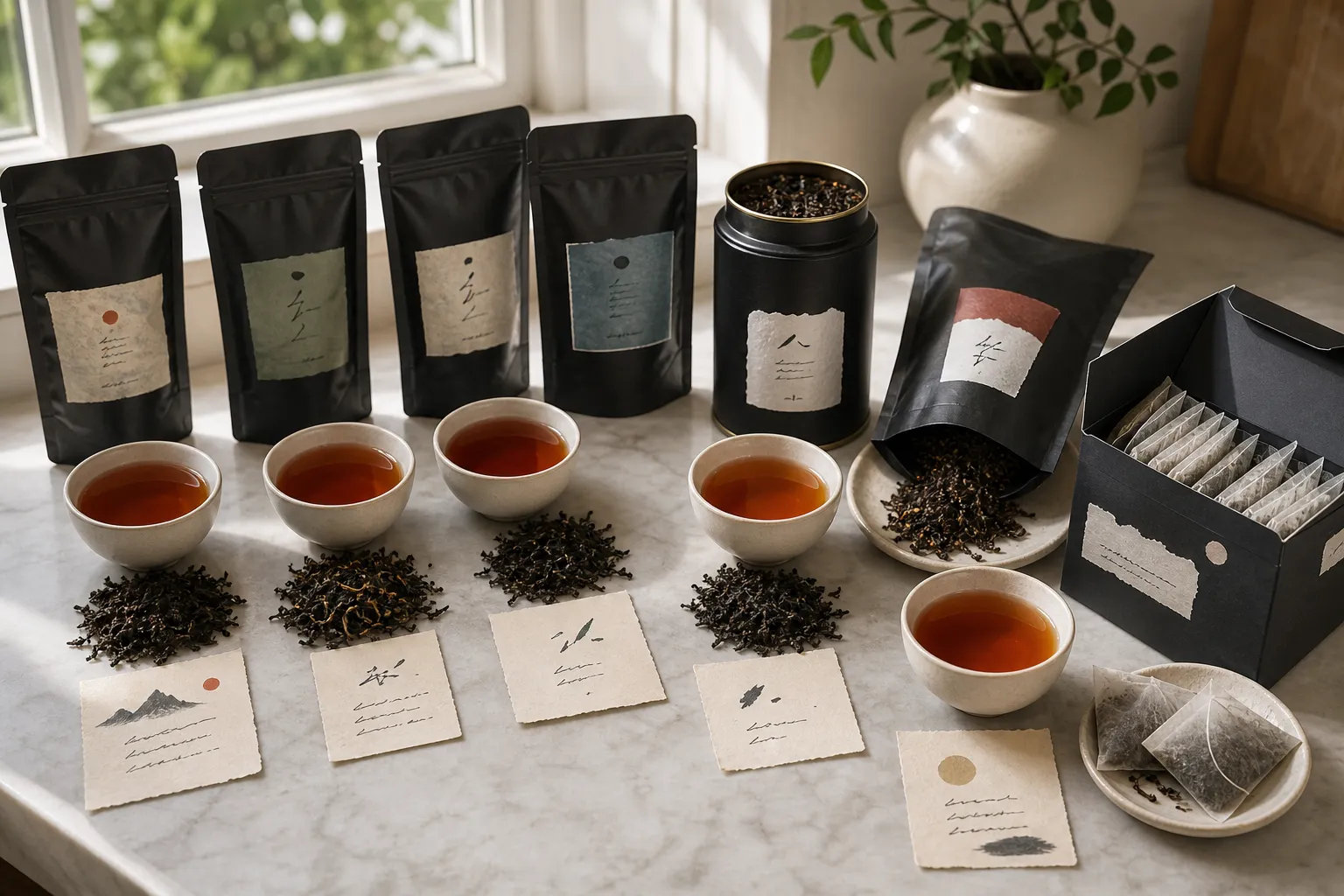
Black tea labels usually answer one or more of four questions: where the tea comes from, how the leaf is presented, whether it is a single-origin tea or a blend, and how the cup is expected to behave. A package may say “Assam black tea,” “Ceylon breakfast blend,” “Keemun loose leaf,” “CTC tea,” or simply “black tea bags.” Each phrase gives a different kind of clue.
Origin names are the most familiar entry point, but they are not complete descriptions. A region name may suggest a general cup direction, yet it does not tell you the exact harvest, grade, storage condition, or brewing result. Blend names are looser still. “Breakfast” often signals a stronger cup that can stand up to milk, but the actual tea components and proportions can differ by maker.
Leaf style matters because it changes how quickly the tea gives color and strength to the water. Fine particles and CTC-style teas tend to infuse quickly and can become assertive fast. Larger orthodox leaves often reveal aroma and texture more gradually, though broken orthodox leaf can still brew with strength. Packaging format matters too: tea bags are convenient and fast, while loose leaf gives you more control over quantity, expansion, and adjustment.
| Label clue | What it helps you predict | What it cannot promise |
|---|---|---|
| Origin wording | General style family, possible aroma direction, common serving expectation | Exact flavor, quality, harvest character, or authenticity |
| Leaf appearance | Infusion speed, strength, clarity, amount of sediment | Whether the cup will be better for every drinker |
| Blend name | Likely use case, especially milk, sugar, breakfast service, or everyday brewing | A fixed formula across brands |
| Package format | Convenience, portion control, storage exposure, brewing control | Freshness or cup quality by itself |
A good first reading is simple: origin suggests family, leaf form suggests brewing speed, blend name suggests serving use, and freshness decides how lively the cup feels. Taste first, then compare the variety.
A Practical Map of Black Tea Types
The phrase black tea types can mean several overlapping things. A tea buyer may use it to ask about regional varieties. A brewer may use it to ask why one cup tastes brisk and another tastes soft. A shop may use it to organize shelves by country, grade, blend, or leaf form. None of those uses is wrong; they are just different maps.
Five broad lanes
- Regional and origin styles — teas identified by place names or origin language, such as Indian, Ceylon, or Chinese black teas.
- Named varieties or style names — familiar names such as Assam, Darjeeling, Nilgiri, Keemun, Yunnan, and Lapsang Souchong.
- Blends — teas mixed to produce a target cup, often sold under names such as English Breakfast, Irish Breakfast, or Scottish Breakfast.
- Leaf styles — orthodox, broken leaf, fannings, dust, CTC, loose leaf, and bagged formats.
- Serving styles — plain sipping, milk tea, lemon tea, iced tea, sweetened tea, or stronger breakfast preparation.
These categories overlap on the package. A tea can be Ceylon, orthodox, loose leaf, and part of a breakfast blend at the same time. Another can be Assam, CTC, bagged, and intended for milk. The name does not sit in one neat box.
The root question is not “Which black tea type is best?” It is “Which black tea type matches the cup I want today?” If you want strong color and quick body, start with leaf form and blend style. If you want aroma detail, start with origin and larger leaf. If you want consistency, look at blends. If you want contrast and learning, compare single-origin examples side by side.
A common buying mistake
A common buying mistake is treating origin, blend, and leaf form as if they are the same kind of label. They are not.
- Origin tells you where the tea is presented as coming from.
- Style name tells you the market or regional name the seller is using.
- Blend tells you the tea may combine multiple components for a target taste.
- Leaf form tells you something visible about particle size, shape, and brewing behavior.
- Serving cue tells you how the seller expects many drinkers to use it.
If a label says “English Breakfast,” it may not tell you one origin. If it says “Assam,” it may not tell you whether the leaf is large, broken, or CTC. If it says “loose leaf,” it does not tell you whether the taste will be malty, floral, smoky, or brisk. Read the whole label before judging the tea.
Black Tea Origins as Buyer Language
Black tea origins are often used as shorthand for flavor expectation, but origin language needs care. A place name can be useful on the shelf, yet it cannot replace looking at the leaf, smelling the dry tea, checking freshness, and brewing with a steady ratio. The same named origin may include many producers, harvests, grades, and styles.
For root-level buying, origin works best as a navigation tool. It helps you decide which shelf to explore, which comparison to make, and which child topic to read next. It should not be treated as a strict promise that every cup from the same named place will taste identical.
| Origin or style name | Common buyer expectation | What to check in the cup |
|---|---|---|
| Assam black tea | Fuller body, strong color, often milk-friendly | Does the strength feel rounded or drying? |
| Darjeeling black tea | More aroma focus, lighter body, seasonal variation | Does the fragrance hold without milk? |
| Nilgiri black tea | Brightness, flexibility, sometimes iced-tea usefulness | Does the cup stay clear and lively as it cools? |
| Ceylon black tea styles | Briskness, clarity, plain, lemon, milk, or iced use depending on strength | Does the tea feel bright, sharp, rounded, or thin? |
| Keemun black tea | Fragrant, smoother, often plain-sipping appeal | Is the aroma still clear after steeping? |
| Yunnan black tea | Richer or sweet-leaning market expectation, sometimes golden-tipped leaf | Does the body match the appearance? |
| Lapsang Souchong tea | Smoky character, with smoke level varying by product | Is the smoke balanced with tea flavor? |
These are buyer expectations, not tasting verdicts. A broken Assam may brew very differently from a whole-leaf Assam. A Darjeeling from one season may not behave like another. A Ceylon label with regional or elevation wording may invite a more specific comparison, while a simple “Ceylon” label still needs to be judged by aroma, color, briskness, and steeping response.
Chinese black tea styles often enter English-language tea shelves through names such as Keemun, Yunnan, and Lapsang Souchong. These names usually point readers toward aroma and style differences rather than milk-first strength. They are good places to slow down the brew and smell the cup before adding anything. If the aroma is the point, too much leaf, too long a steep, or very hard water may push bitterness and astringency ahead of quieter details.
A root page cannot responsibly turn every origin name into a full regional guide, especially without a stronger public source set for this draft. Buyers may also see labels that mention Kenya, Nepal, Indonesia, Rwanda, Malawi, Turkey, Vietnam, and other black-tea-producing regions. The practical move is the same: do not make the country name carry the whole decision. Look for leaf size, freshness, harvest or lot wording if present, blend context, and suggested brewing. Then decide whether the cup is meant for briskness, aroma, milk, iced tea, or plain sipping.
Black Tea Styles by Cup Character
Most readers do not choose tea by taxonomy. They choose by the cup they want: strong, fragrant, smooth, brisk, smoky, bright, mellow, or milk-friendly. This is where black tea varieties become easier to understand. Style names matter, but sensory language makes them usable.
Five cup traits
- Body
How full or weighty the tea feels in the mouth. - Briskness
The lively, crisp edge that makes the cup feel alert and clean. - Astringency
The drying grip on the tongue or gums. - Aroma
The smell rising from the wet leaf and cup. - Finish
The flavor and texture left after swallowing.
A tea can be strong without being complex. It can be aromatic without being heavy. It can be brisk in a pleasant way or a drying way, depending on leaf, water, time, and personal tolerance. The buyer’s job is not to memorize every style; it is to connect the label with what actually happens in the cup.
| If you want… | Start with… | Brewing watchpoint |
|---|---|---|
| A stronger cup | Breakfast blends, Assam black tea, broken leaf, CTC, or tea bags designed for breakfast use | Increase leaf before adding much more time; long steeps can add roughness |
| More aroma | Loose leaf, larger orthodox leaf, Darjeeling, Keemun, some Yunnan, selected Ceylon styles | Taste plain first and avoid covering the scent with too much milk or sweetener |
| A softer plain tea | Larger-leaf orthodox teas, Keemun, Darjeeling, some Yunnan or lighter Ceylon examples | Shorten the steep before blaming the variety |
| Smoke or bold edges | Lapsang Souchong tea, assertive breakfast blends, or clearly labeled flavored blends | Check whether the smoke, spice, or flavoring is part of the tea style or an added ingredient |
| Everyday flexibility | Nilgiri, Ceylon, balanced breakfast blends, or reliable loose-leaf house blends | Compare plain, with milk, and as the cup cools |
For a stronger cup with less harshness, try increasing leaf before increasing time. Time extracts more of the drying edge; more leaf can give body while keeping the steep controlled. For a softer cup, do the opposite: shorten the steep first, then adjust leaf amount if the result becomes too thin.
Orthodox vs CTC Black Tea
Orthodox vs CTC black tea is one of the most useful comparisons for understanding why two black teas can behave so differently in the pot. This comparison is not only about quality. It is about leaf appearance, infusion speed, strength, aroma detail, and common use.
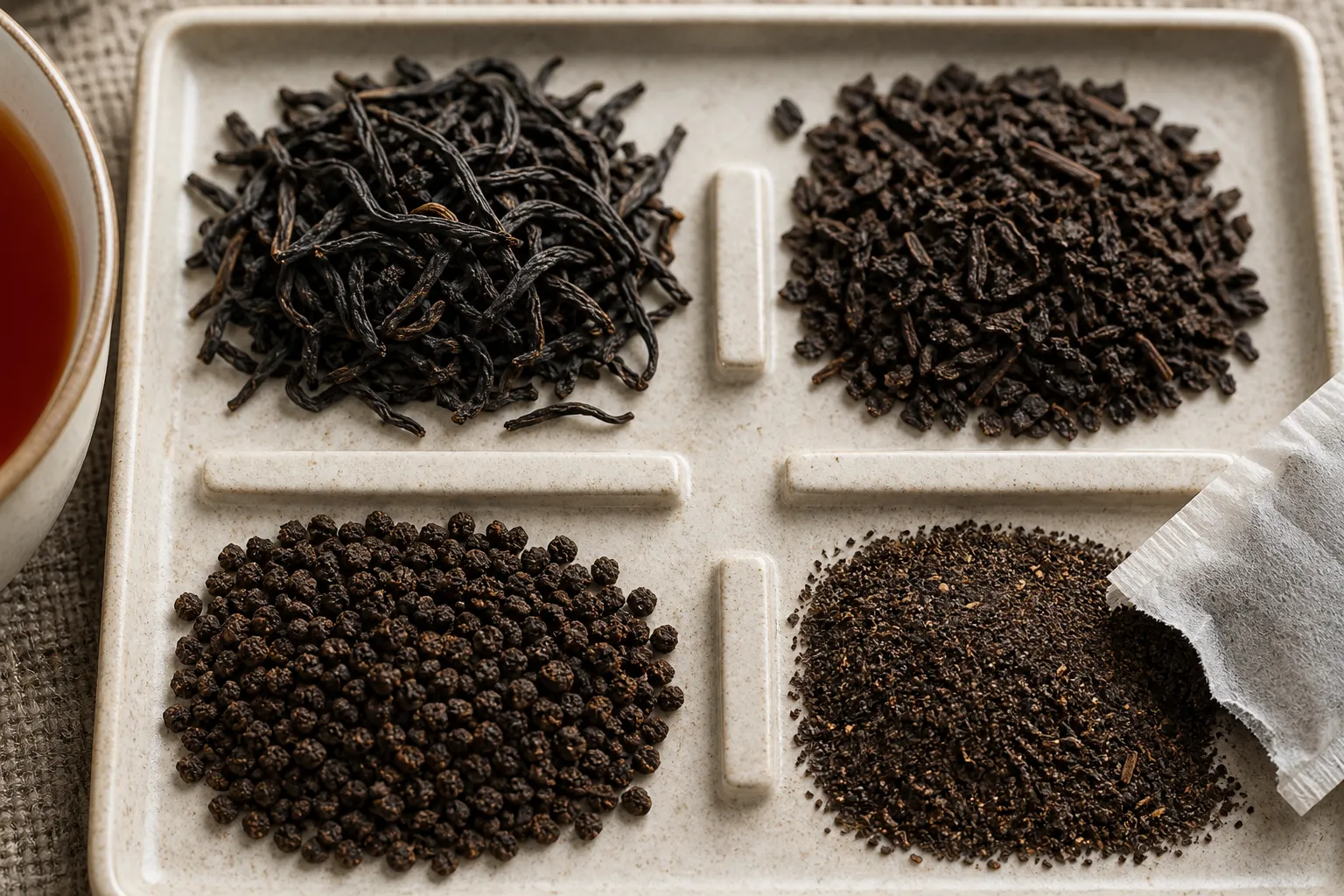
Orthodox black tea usually appears as rolled, twisted, curled, wiry, or broken pieces that still show some leaf shape. CTC black tea usually appears as small, fairly uniform granules. The visual difference matters because it tells you how quickly water can reach the surface of the leaf particles. Smaller pieces tend to release color and strength faster.
That does not mean one form is always better. It means they suit different habits. A CTC tea can be practical for a fast, strong, milk-ready cup. An orthodox tea may give more room to notice aroma changes, texture, and the way the leaf opens. Broken orthodox leaf can sit between those experiences: faster and stronger than large leaf, but not identical to CTC granules.
| Leaf style | What you can see | Common cup expectation | Brewing watchpoint |
|---|---|---|---|
| Larger orthodox leaf | Twists, curls, wiry pieces, visible leaf structure | Slower release, more room for aroma and texture | Give the leaf enough space and enough measured tea |
| Broken orthodox leaf | Smaller pieces, less intact leaf shape | Quicker strength, more briskness | Can turn dry if steeped too long |
| CTC | Small, dense granules | Fast color, strong body, milk-friendly use | Watch steep time closely |
| Fannings or dust | Very small particles, often in tea bags | Very fast infusion, strong color | Can become harsh quickly |
| Mixed blend | Varied particle sizes | Designed for a target cup rather than one leaf expression | Follow the maker’s time, then adjust |
A deeper comparison can explore processing and grading in more detail. At root level, the takeaway is direct: look at the leaf before choosing a steep time.
Breakfast Tea Blends and Serving Style
Breakfast tea blends are some of the most familiar black tea styles for everyday buyers. Names such as English Breakfast, Irish Breakfast, and Scottish Breakfast usually suggest a cup built for strength, routine, and milk compatibility. They do not function like exact formulas. One maker’s English Breakfast may not match another maker’s blend, even if both aim for a bold morning cup.
Breakfast blend names are use-case labels before they are origin labels.
| Blend name | Practical buyer signal | What to check |
|---|---|---|
| English Breakfast | Balanced, familiar black tea blend for a morning cup | Does it taste better plain or with milk? |
| Irish Breakfast | Often marketed as stronger or more robust | Does the strength come with pleasant body or too much dryness? |
| Scottish Breakfast | Often positioned as very bold or hearty | Does it need milk, sugar, or a shorter steep? |
| House Breakfast | A seller’s own target profile | Does it lean malty, brisk, bright, smoky, or smooth? |
| Decaf Breakfast | Breakfast-style taste with reduced caffeine by processing | Expect a different aroma and body from the regular version |
Because blend names are not fixed recipes across the market, compare them by cup behavior. Use the same mug, the same water volume, and the same steep time. Add milk only after tasting the plain tea once. That single plain sip tells you whether the blend has aroma under the strength or only color and grip.
Serving style should match the cup. A brisk, strong tea may soften with milk. A bright, clean tea may work with lemon. A delicate aromatic tea may lose detail when heavily sweetened. A smoky tea may be loved plain by one drinker and softened by food or milk by another.
There is no need to turn preference into a rule. If the tea tastes thin with milk, use less milk, more leaf, or a different blend. If lemon makes the cup seem sharp, try a shorter steep or choose a brighter but less drying tea. If sugar hides the flavor, taste the next cup unsweetened first.
Brewing Expectations by Type
Brewing is where style names become real. The same black tea can taste balanced, flat, sharp, or heavy depending on leaf amount, water temperature, steeping time, cup size, and storage condition. A root page should not pretend there is one universal black tea method that fits every product perfectly.
Most black teas are brewed with hot water and a short-to-moderate steep, but the exact time should respond to leaf size and desired strength. Smaller particles infuse faster. Larger leaves often need more room and may benefit from a steadier, less rushed approach. A tea bag in a mug and loose leaf in a pot are not the same brewing situation.
Starting method
- Warm the cup or pot if you want steadier heat.
- Measure the tea rather than guessing from leaf volume alone.
- Use freshly heated water suitable for black tea.
- Steep briefly at first, especially with small leaf or tea bags.
- Taste before adding milk, sugar, or lemon.
- Adjust one variable at a time: leaf amount, time, water volume, or serving addition.
| If the tea is… | Start by watching… | Likely adjustment |
|---|---|---|
| CTC or very small particle | Infusion speed and drying edge | Shorten time; add milk after tasting |
| Large loose leaf | Expansion and aroma release | Give the leaf room; use enough tea |
| Breakfast blend | Balance of strength and roughness | Control time before adding milk |
| Aromatic origin tea | Scent from dry and wet leaf | Avoid oversteeping; taste plain first |
| Smoky tea | Smoke intensity and aftertaste | Use a lighter hand if the aroma dominates |
| Older or poorly stored tea | Flat aroma, stale smell, dull color | Replace or reserve for blending rather than overbrewing |
For a tea that tastes weak, add more leaf before adding much more time. For a tea that tastes bitter or drying, shorten the steep before changing the origin. For a tea that smells dull, check freshness and storage before assuming the style is boring.
Brewing is a diagnostic tool. It helps you separate “I dislike this style” from “I brewed this style in a way that emphasized the wrong trait.”
Storage, Freshness, and Fair Comparisons
Storage is not glamorous, but it changes how fairly you can judge black tea styles. A stale Assam, a tired Keemun, or a badly stored Ceylon can make the whole category seem less interesting than it is. Before deciding that a variety is not for you, look at how the tea has been kept.
Black tea should be protected from air, moisture, light, heat, and strong odors. The practical container is clean, dry, and well sealed. A clear jar on a sunny shelf may look attractive, but it is not ideal for preserving aroma. A paper pouch opened many times in a humid kitchen may lose liveliness. Tea stored near spices, coffee, or scented products can pick up unwanted smells.
Freshness is especially important when comparing teas. If one sample is newly opened and another has been exposed for months, the comparison is not fair. The fresher tea may seem brighter simply because it has been better protected.
Quick storage check
- Smell the dry leaf before brewing; dull, flat, or foreign odors matter.
- Check whether the container seals well after each use.
- Keep tea away from steam near the kettle or stove.
- Avoid storing black tea beside strong-smelling foods or cleaning products.
- Label opened tea with a date if you compare many varieties.
- Use older tea for casual milk tea or blending before using fresh samples for style comparison.
Store the leaf before judging the brew. A clean storage habit makes black tea origins and varieties easier to compare honestly.
Buying Vocabulary Without Getting Lost
Black tea buying language can be helpful, but it can also crowd the label with more confidence than the package deserves. Words such as premium, finest, golden, tippy, estate, breakfast, broken, orthodox, CTC, high grown, single origin, handpicked, rare, strong, smooth, and aromatic may appear. Some are descriptive. Some are market language. Some need context before they mean much.
For a cautious buyer, the best labels are the ones that give observable information: origin, leaf style, harvest or batch when relevant, ingredients, flavoring disclosure, package date or best-by date, brewing suggestion, and whether the tea is loose leaf or bagged. Vague praise is less useful than visible leaf and clear preparation guidance.
Questions before buying
- Is this a single-origin tea, a regional blend, or a named breakfast blend?
- Is the leaf whole, broken, CTC, fannings, dust, or hidden inside a bag?
- Is the tea plain black tea, scented black tea, or flavored black tea?
- Is the intended cup plain, with milk, with lemon, iced, or sweetened?
- Does the package give a steep time and leaf amount?
- Is there enough freshness information to compare it with other teas?
Some words sound precise but need context. “Strong” may mean high leaf amount, small particles, long steeping, or a blend designed for milk. “Smooth” may mean low bitterness to one seller and soft body to another. “Golden tips” may describe visible leaf material, but the cup still depends on the tea. “Breakfast” suggests use, not a fixed recipe. “Single origin” gives a sourcing clue, not an automatic quality rank.
The safest purchase is not always the most decorated label. It is the tea whose wording helps you predict how to brew it and how it is likely to behave in your cup.
Common Misreadings of Black Tea Types
Black tea is easy to overclassify. A shelf can make the topic look like a strict hierarchy, but the cup is more flexible than that. Avoid these common misreadings when comparing styles.
| Misreading | Better way to read it |
|---|---|
| Dark color means better strength | Color can suggest concentration, small particles, or a long steep, but texture, aroma, and balance matter too. |
| Origin guarantees flavor | Origin gives a family clue; harvest, leaf style, processing choices, grade, storage, and brewing still change the cup. |
| Loose leaf is always gentle | Loose leaf gives control, but broken loose leaf can brew quickly and large leaves can still become rough when oversteeped. |
| Tea bags are always inferior | Bags can be useful for convenience and consistency, especially when the intended cup is quick and milk-friendly. |
| Breakfast names are fixed recipes | English, Irish, and Scottish Breakfast names vary by maker; judge the blend by cup behavior. |
| A stale tea represents the style | Flat aroma or foreign odors may point to age or storage before they point to origin or variety. |
Taste color with texture. Ask whether the cup feels full, brisk, thin, sharp, round, or flat. Compare origin teas under the same brewing conditions before drawing conclusions. If you actually drink breakfast blends with milk, taste them side by side with the same milk amount.
Good comparison habits make preferences clearer.
A Simple Tasting Framework for Comparing Black Tea
You do not need formal tasting equipment to compare black tea types at home. You need consistency. Use the same cup size, water, leaf amount, and steep time for the first round. Then adjust only one variable for the second cup.
Start with three teas if possible: one stronger breakfast or Assam-style tea, one aromatic style such as Keemun or Darjeeling, and one Ceylon or Nilgiri-style tea chosen for brightness or everyday flexibility. If you are curious about leaf form, compare an orthodox loose leaf with a CTC or tea bag version.
Record what you can use again
- Dry leaf: size, shape, color variation, scent, dust level.
- Wet leaf: aroma after steeping, expansion, particle size.
- Liquor: red, amber, copper, brown, or very dark appearance.
- First sip: body, sweetness, sharpness, bitterness, briskness.
- Middle cup: how the tea behaves as it cools.
- Finish: drying, clean, smoky, fruity, malty, floral, flat, or lingering.
- Serving test: plain first, then milk, lemon, sugar, or ice if relevant.
Do not overbuild the notes. A short line such as “fast color, strong body, dries after three minutes, good with milk” is more useful than a poetic description you cannot repeat. The goal is buyer memory: you want to know what to buy again, what to brew differently, and what style to explore next.
Caffeine and Personal Tolerance
Black tea naturally contains caffeine, and drinkers vary in how they respond to it. For choosing among black tea types, the useful advice is modest: pay attention to your own tolerance, serving size, steep strength, and timing. A large mug of strong black tea late in the day may feel different from a small morning cup, and individual sensitivity matters.
This page is about types, origins, styles, brewing, storage, and buyer vocabulary, not health outcomes. If caffeine, sleep, digestion, hydration, or other personal concerns affect your tea choices, treat black tea as a food-and-drink preference question first and seek appropriate professional guidance for higher-stakes concerns.
For ordinary choosing, the cup-level approach still helps: lighter steep, smaller serving, decaf breakfast blend, or a different time of day may make more sense than forcing a strong tea into a routine that does not suit you.
Reader Paths Into the Main Black Tea Styles
A root page should point you toward the next useful comparison, not bury you under every regional detail at once. Use these paths when a label or cup raises a specific question.
| If you are wondering… | Start here | What the deeper topic should help with |
|---|---|---|
| Why Assam, Darjeeling, and Nilgiri taste so different | Indian black tea styles | Body, aroma, astringency, harvest character, and common serving use |
| Why Ceylon teas can seem bright, brisk, or differently balanced | Ceylon black tea styles | Elevation language, regional cues, strength, brightness, and serving style |
| How Keemun, Yunnan, and Lapsang Souchong differ | Chinese black tea styles | Aroma, sweetness, smoke, body, and brewing expectations |
| What English, Irish, and Scottish Breakfast names mean | Breakfast tea blends | Strength, milk compatibility, origin components, and flexible blend naming |
| Why some teas brew fast and strong while others unfold slowly | Orthodox vs CTC black tea | Leaf appearance, infusion speed, body, astringency, and common format use |
These are doorways, not verdicts. A reader who loves milk tea may begin with breakfast blends or Assam. A reader who wants aroma may begin with Chinese styles or Darjeeling. A reader who keeps overbrewing tea bags may learn more from the orthodox vs CTC path than from origin names.
How to Choose Your Next Black Tea
Choose your next black tea by the problem you are trying to solve, not by the longest name on the package.
If your tea tastes weak, try a fuller-bodied blend, a smaller leaf style, or a slightly higher leaf amount. If your tea tastes too harsh, shorten the steep, choose a larger-leaf style, or move toward a smoother origin or blend. If your tea smells dull, check freshness and storage before buying more of the same. If you want milk tea, start with breakfast blends, Assam black tea, or CTC-style teas that are meant to carry strength. If you want aroma, look at Darjeeling black tea, Keemun black tea, Yunnan black tea, selected Ceylon teas, or other loose-leaf styles where the scent matters.
The best black tea path is a small set of comparisons: one origin, one blend, one leaf style, and one brewing adjustment. Brew them carefully, taste before adding anything, and let the cup tell you which name is worth following next.
Source note
No public reference links were available in the reviewed packet for this draft. The article therefore keeps claims at the level of observable label language, leaf appearance, brewing behavior, storage practice, and cautious buyer expectations rather than presenting detailed regional, historical, processing, grading, or health claims as sourced conclusions.