
Western brewing method
How to Brew Black Tea Western Style
If you searched for how to brew black tea western style, you are probably trying to make a dependable mug or pot without ending up with tea that is thin, harsh, or lost under milk. The useful starting point is straightforward: use enough tea, pour on near-boiling water, time the steep, and remove the leaves when the steep is done.
Start here, then adjust by taste:
Loose leaf
About 2.5 g black tea for 6–8 oz / 180–240 ml water, or 5 g for 12–16 oz / 350–475 ml.
Tea bag
Usually one bag for one mug, unless the package gives different instructions.
Water
Near boiling to boiling, roughly 205°F / 96°C to 212°F / 100°C.
Time
Begin around 3–4 minutes.
Finish
Remove the leaves, basket, strainer, or bag before drinking.
Those numbers are a starting recipe, not a rule for every tea. Black tea varies by origin, grade, leaf size, freshness, blend, and intended use. Treat the first cup as a calibration brew: taste it plain, then decide whether the next cup needs more leaf, less time, hotter water, or a milk-friendlier strength.
upward
Start with the broader guide
Use the broader guide first if you need the full scope before this page.
What Western Style Brewing Means for Black Tea
Western black tea brewing usually means making tea in a mug or teapot with a relatively large amount of water and one longer infusion. It is the familiar home and café pattern: tea leaves or a tea bag sit in hot water for several minutes, then the leaves are removed and the cup is served.
That differs from small-vessel traditional methods, where more leaf is used with less water, steeps are much shorter, and the same leaves may be infused many times. Those methods can be excellent, but they are not the focus here. This black tea steeping guide is about a practical mug or pot.
Western-style brewing also should not be confused with formal sensory preparation. Technical tea standards exist for preparing tea liquor in controlled tasting contexts, but a standardized tasting liquor is not the same thing as the cup you may prefer at breakfast, at work, or with milk. At home, the useful test is whether the tea’s aroma, body, briskness, sweetness, and astringency suit the tea and the drinker.
Main variables in the cup
Tea-to-water ratio
Strength, body, color, and concentration.
Leaf form
Extraction speed and how accurately teaspoons measure.
Water temperature
Aroma release, extraction, and perceived fullness.
Steep time
Strength, briskness, bitterness, and astringency.
Leaf removal
Whether the cup keeps getting stronger as you drink.
Milk timing
Whether the tea extracts fully before being cooled and diluted.
Water quality
Clarity, brightness, aroma, and mouthfeel.
Food-science research broadly supports the idea that temperature, time, water composition, and tea-to-water ratio affect extraction. It does not provide one universal home recipe for every black tea, which is why a starting range plus tasting adjustment works better than a rigid rule.
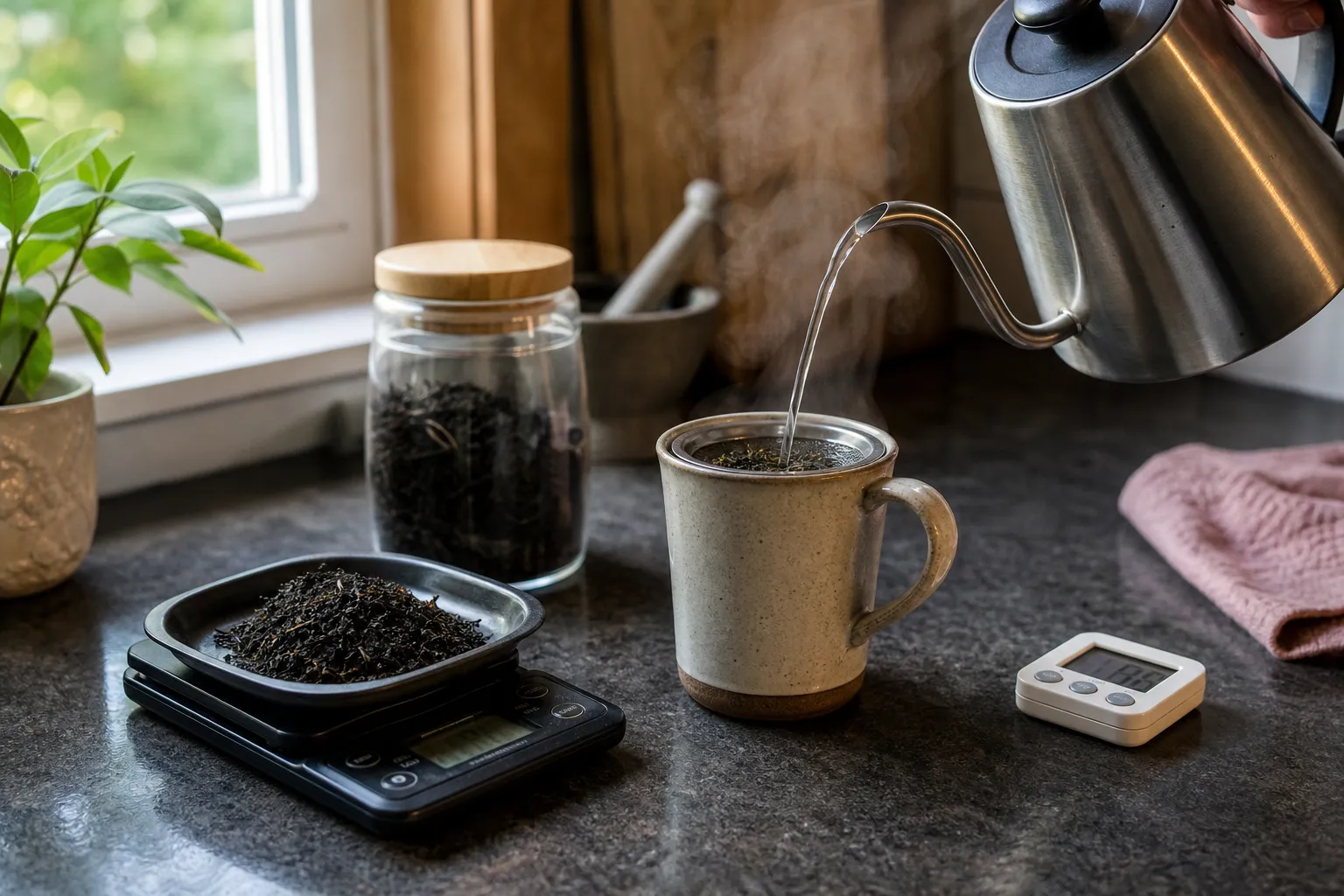
How to Brew Loose Leaf Black Tea in a Mug With an Infuser Basket
A mug and infuser basket are often the easiest way to brew black tea in a mug because the leaves have room to open and can be removed cleanly.
- Warm the mug if you want a steadier brew. This is optional, but rinsing a thick ceramic mug with hot water can reduce heat loss, especially in a cold kitchen.
- Measure the tea. Start with about 2.5 g for 6–8 oz / 180–240 ml water. If you do not have a scale, use the package guidance or begin with roughly a level to modestly heaped teaspoon, knowing that spoons are approximate.
- Use a roomy infuser basket. A basket that fills much of the mug opening usually gives leaves more space than a small ball infuser. Dry leaves swell as they hydrate, and cramped leaves often brew unevenly.
- Add near-boiling water. For most black teas, use water just off the boil or fully boiled water poured promptly. Some delicate black teas may taste smoother with slightly cooler water, but everyday black teas are generally brewed hot.
- Start the timer when water hits the leaves. Begin with 3 minutes if you are cautious about bitterness, or 4 minutes if you want a fuller, milk-friendly cup.
- Remove the basket when the timer ends. Let it drain, but do not press or squeeze the wet leaves hard. Pressing can make the cup seem harsher.
- Taste before changing anything. If the tea is too weak, adjust the next cup. If it is too bitter, adjust the next cup. Changing leaf amount, time, and temperature all at once makes it harder to know what helped.
The key advantage of the basket is control. Once the steep is done, the leaves leave the cup. The tea does not keep extracting while you sip.
How to Brew Black Tea in a Teapot Without Leaving the Leaves Steeping
A teapot can make a round, shared cup, but it also creates the most common Western-style problem: the leaves stay in the pot and continue steeping. By the second pour, the tea may be darker, rougher, and more astringent than the first.
There are three clean ways to avoid that.
Use a teapot with a removable infuser
This is the simplest teapot method.
- Measure about 5 g tea for 12–16 oz / 350–475 ml water, then scale up for a larger pot.
- Add the tea to the teapot infuser.
- Pour near-boiling water over the leaves.
- Steep for 3–4 minutes.
- Remove the infuser completely.
This keeps the whole pot closer to the flavor you intended.
Brew loose, then strain into another vessel
If your teapot has no removable basket, brew the leaves loose, then pour the entire pot through a strainer into a second warmed teapot or heat-safe serving jug when the time is up.
The important detail is to separate all the liquid from all the leaves. Pouring only one cup and leaving the rest on the leaves will change the remaining tea.
Use tea bags, but still remove them
Tea bags are not exempt from over-extraction. If a bag sits in the teapot for ten or twenty minutes, later cups may become heavy or bitter. Treat a bag like loose leaf: steep, remove, serve.
Should You Preheat the Teapot and Cover Black Tea While It Steeps?
Preheating and covering are not ceremonial requirements, but they can help with temperature control.
A cold teapot pulls heat out of the water. If you are using a large ceramic pot, a quick rinse with hot water before brewing can help the infusion stay hotter during the steep. This matters more for a full pot than for a small mug, and more in a cold room than a warm one.
Covering the pot or mug can also help retain heat and aroma. A lid is especially useful when:
- The room is cool.
- The vessel is wide and loses heat quickly.
- You are brewing a full-bodied tea meant for milk.
- You want a more repeatable result.
For a quick mug of black tea, uncovered brewing is not automatically wrong. If the cup tastes thin even with the right amount of leaf and time, heat loss may be worth testing. Preheat the vessel, cover it, and see whether the tea gains body and aroma.
Grams Versus Teaspoons for Tea
A scale is more repeatable than a spoon because black tea leaves do not all occupy space the same way.
One teaspoon of dense pellets, small broken leaf, or fine tea may contain much more actual tea than one teaspoon of long twisted leaves. A fluffy, wiry black tea can look like a generous spoonful while weighing less than expected. Golden buds, rolled leaves, chopped grades, and broad leaf pieces all settle differently.
That is why grams are better for repeatability. If one cup tastes right at 2.5 g per mug, you can repeat it even when you change teas.
Teaspoons are still useful. Many readers brew without a scale, and many tea packages give spoon-based instructions. Just read spoon measures as a starting language, not a precise dose. If your black tea tastes too weak and the leaves are bulky, you may be undermeasuring by volume. If it tastes harsh and the leaf is fine or broken, your “one spoon” may be stronger than you think.
A practical way to learn your own teas
- Weigh one usual spoonful once.
- Notice whether the leaf is dense, broken, twisted, or fluffy.
- Write the dose on the packet if you like the result.
- Adjust by small amounts next time.
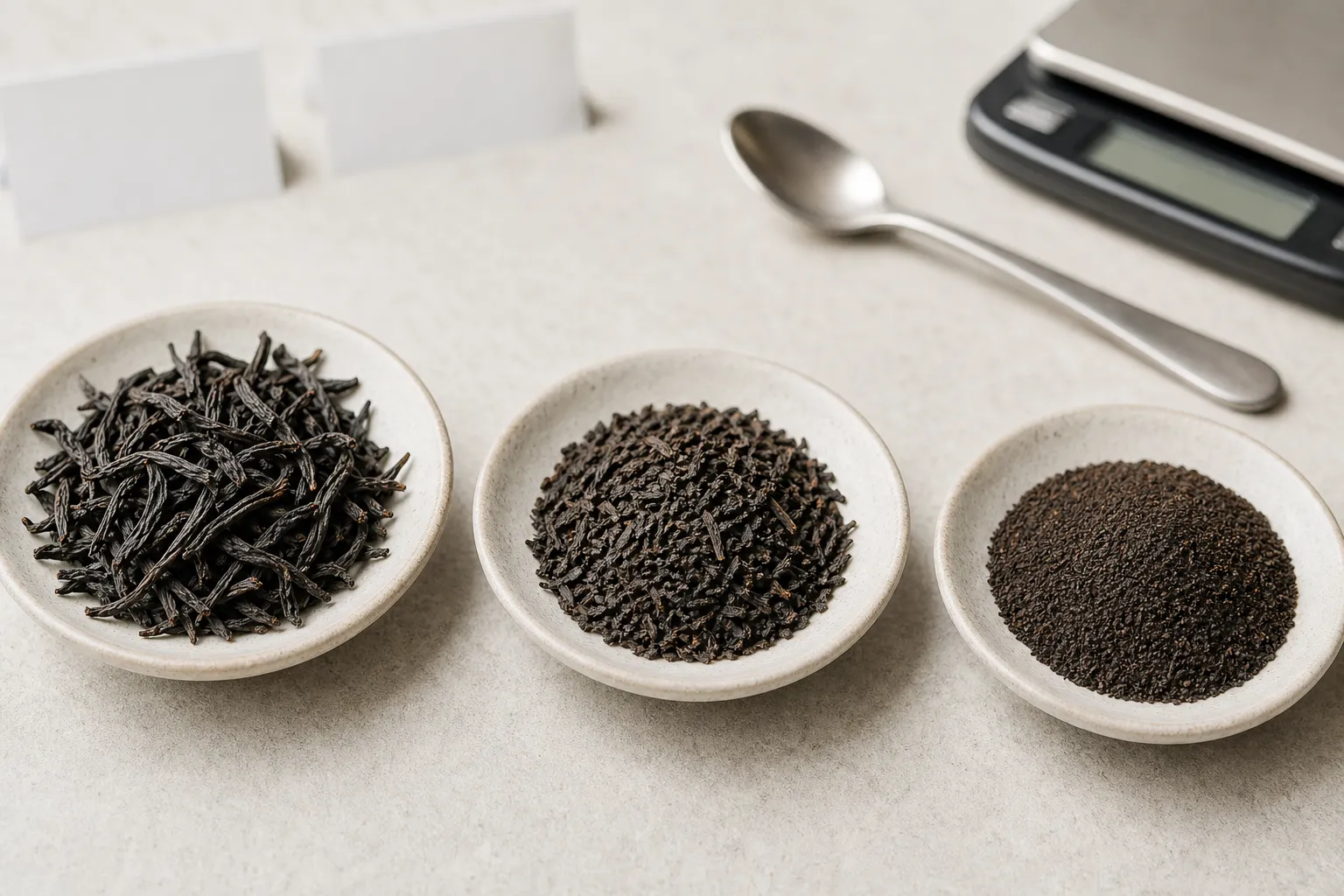
Whole Leaf vs Broken Leaf Black Tea in Western Brewing
Whole leaf and broken leaf black teas can both make good Western-style cups, but they often behave differently.
Whole leaf black tea
Whole leaf black tea may open more slowly. It can give a layered aroma, a clearer sense of leaf character, and a smoother build across the steep. Depending on the tea, it may need the full 3–4 minutes, sometimes a little more, to show enough body in a large mug.
Broken leaf black tea
Broken leaf black tea usually extracts faster because more surface area is exposed to water. It can brew strong, dark, brisk, and milk-friendly, but it may also become astringent more quickly if steeped too long or measured too heavily.
Fine grades and many tea bags
Fine grades and many tea bags tend to infuse quickly. This is one reason a bagged black tea may seem strong after only a few minutes while a long-leaf tea still tastes light at the same time.
This does not mean whole leaf is always delicate or broken leaf is always harsh. Origin, processing, freshness, and blend design matter. The practical difference for Western brewing is speed and control:
- If the tea is whole, twisted, or bulky, check whether you used enough weight.
- If the tea is small, broken, or dusty, watch steep time carefully.
- If the cup becomes rough before it becomes flavorful, reduce time before reducing water temperature.
- If the cup is fragrant but thin, increase leaf amount before pushing the steep much longer.
Tea Bag vs Loose Leaf Black Tea in Western Brewing
Tea bags are convenient and can make a satisfying cup, especially when the tea is intended for quick extraction and milk. Loose leaf gives more control over dose, leaf space, and the style of tea you choose.
The brewing principles are the same:
- Use enough tea for the water.
- Use hot enough water.
- Steep for a set time.
- Remove the tea.
- Adjust by taste.
The differences are practical. A tea bag is pre-portioned, so the package has already made decisions about dose and leaf size. That helps with consistency, but gives you less room to fine-tune. If the tea is too strong, shorten the steep or use more water. If it is too weak, steep a little longer, use less water, or choose a stronger tea rather than leaving the bag in indefinitely.
Loose leaf lets you choose the ratio. You can make a lighter afternoon cup, a stronger breakfast-style cup, or a pot sturdy enough for milk by changing grams, water, and time. The tradeoff is that you must separate the leaves from the liquor, either with an infuser basket, teapot strainer, or second vessel.
A strainer and an infuser basket are not the same tool. A strainer catches leaves as you pour. An infuser basket holds leaves during the steep and lifts out afterward. For Western black tea, a roomy basket is usually easier than a tiny enclosed infuser because the leaves can swell and circulate more freely.
When to Remove Black Tea Leaves in Western Brewing
Remove black tea leaves when the steeping time is complete, usually around 3–4 minutes for a starting Western-style cup. If you want a stronger brew, change the next cup intentionally rather than forgetting the leaves.
Leaving black tea in the water keeps extracting. Some added extraction can bring more body and briskness. Too much can bring a dry, gripping mouthfeel or bitterness, especially with fine broken leaves or a naturally brisk blend.
This is also why a French press-style plunger can be tricky for tea if the leaves remain under the liquid. Pressing the leaves down does not stop extraction. Separating the liquor from the leaf is what matters.
A simple repeatable pattern
- Time the steep.
- Remove or strain the leaves.
- Taste.
- Adjust the next brew.
When to Add Milk to Black Tea
For most Western black tea brewing, brew the tea first and add milk after the leaves have infused. The practical reason is temperature: milk cools the water. Cooler water changes extraction and can make the tea seem thinner if added before the tea has brewed.
A milk-friendly black tea usually needs enough strength, briskness, and body to remain recognizable after dilution. To get there, try one of these adjustments:
- Use a little more tea.
- Steep closer to 4 minutes rather than 3.
- Choose a naturally robust or broken-leaf black tea.
- Use a little less water.
- Add less milk.
Avoid solving weak milky tea by leaving the leaves in the pot for a long time. That often increases roughness more than flavor. It is usually better to increase the tea-to-water ratio or choose a tea style that is built for milk.
Milk timing is also cultural and personal. Some traditions and households care deeply about whether milk goes into the cup before or after the tea. From a brewing-control perspective, the clearest method is to extract the tea in hot water first, then add milk to taste.
Troubleshooting: Black Tea Too Weak, Too Bitter, or Too Flat
Most Western-style black tea problems come from a small set of variables. Change one at a time so you know what helped.
If your black tea is too weak
Possible causes:
- Too little tea for the mug or pot.
- Too much water.
- Steep time too short.
- Water not hot enough.
- Bulky leaves undermeasured by teaspoon.
- Stale tea with faded aroma.
- Leaves packed too tightly in a small infuser.
Try this next:
- Increase the dose slightly.
- Use a scale if teaspoons are inconsistent.
- Steep for 30 seconds longer.
- Use near-boiling water.
- Switch to a roomier infuser basket.
If the tea smells pleasant but tastes thin, dose is often the first thing to check. If it has little aroma at all, freshness and storage may be involved.
If your black tea is too bitter or harsh
Possible causes:
- Too much tea.
- Steeping too long.
- Very fine or broken leaf.
- Squeezing the bag or wet leaves.
- A naturally brisk blend.
- Water held hot on the leaves in a teapot.
Try this next:
- Shorten the steep by 30 seconds.
- Use a little less tea.
- Remove the leaves promptly.
- Avoid pressing the wet leaf.
- Add milk if the tea style suits it.
Bitterness and astringency are related but not identical. Bitterness is a taste. Astringency is the dry, puckering, grippy feeling on the tongue and cheeks. Black tea can be brisk and pleasantly drying without being unpleasantly bitter. The line depends on tea style and personal preference.
If your black tea tastes flat
Possible causes:
- Old tea.
- Water with an odor or dull taste.
- Water left cooling too long.
- Too much milk.
- A cup that is strong in color but low in aroma.
Try this next:
- Use fresh water.
- Brew with hotter water.
- Reduce milk.
- Check the packet’s storage condition.
- Compare the same tea with a slightly different ratio.
Research on water composition suggests that water can affect tea’s sensory and chemical qualities, but the home takeaway is modest: use water that tastes clean to you. If your tap water has a strong smell or taste, it may show up in the cup.
Should You Rinse Black Tea Before Western Brewing?
For ordinary Western-style black tea in a mug or teapot, rinsing is usually not part of the method. A rinse can wash away some early aroma and heat the leaves before the main infusion, but it also adds another variable and is more associated with other tea-brewing contexts.
If a package specifically instructs a rinse, follow the package and judge the result. Otherwise, the clearer starting method is to measure the tea, add hot water, time the steep, and remove the leaves.
Do not use a first rinse as a reliable way to manage caffeine. Black tea contains caffeine, and people vary in sensitivity. If caffeine matters to your routine, handle that as a personal tolerance question rather than a brewing shortcut; for medical concerns, seek appropriate professional guidance.
Can You Re-Steep Black Tea After a Western-Style Infusion?
You can try, but expectations should be modest. Western-style brewing uses a larger water volume and a longer first steep, so the first infusion often takes much of what the leaves can easily give. Some whole leaf black teas may produce a pleasant second cup if steeped again with hot water for a longer time. Many broken-leaf teas and tea bags will taste thin on a second infusion.
A second steep is most worth trying when:
- The tea is whole leaf.
- The first steep was not very long.
- The leaves still smell aromatic.
- You do not need the second cup to match the first.
Treat re-steeping as an option, not the main plan. The core Western-style method is still one controlled infusion, followed by leaf removal.
A Simple Adjustment Framework for the Next Cup
Once you have made one cup, let the result tell you what to change.
Pale, thin, watery
Use more tea or less water.
Aromatic but light
Increase leaf amount before greatly extending time.
Strong color but rough finish
Shorten time or reduce tea slightly.
Bitter aftertaste
Remove leaves sooner; avoid squeezing.
Dry, puckering mouthfeel
Shorten steep or use less fine/broken leaf.
Weak after adding milk
Brew stronger before adding milk.
Flat aroma
Use hotter water, fresher tea, or cleaner-tasting water.
A dependable black tea method is not about forcing every tea into one number. It is about controlling the variables you can see: how much leaf, how much water, how hot, how long, and when the leaves come out. Start with a measured 3–4 minute infusion in near-boiling water, taste the cup, and let the tea show you whether it wants more leaf, less time, a fuller steep, or a gentler hand.
Sources
Sources and further reading
Reference links are limited to sources considered suitable for public citation in this page.