Label reading
How to Read Ceylon Tea Labels for Region, Elevation, and Grade
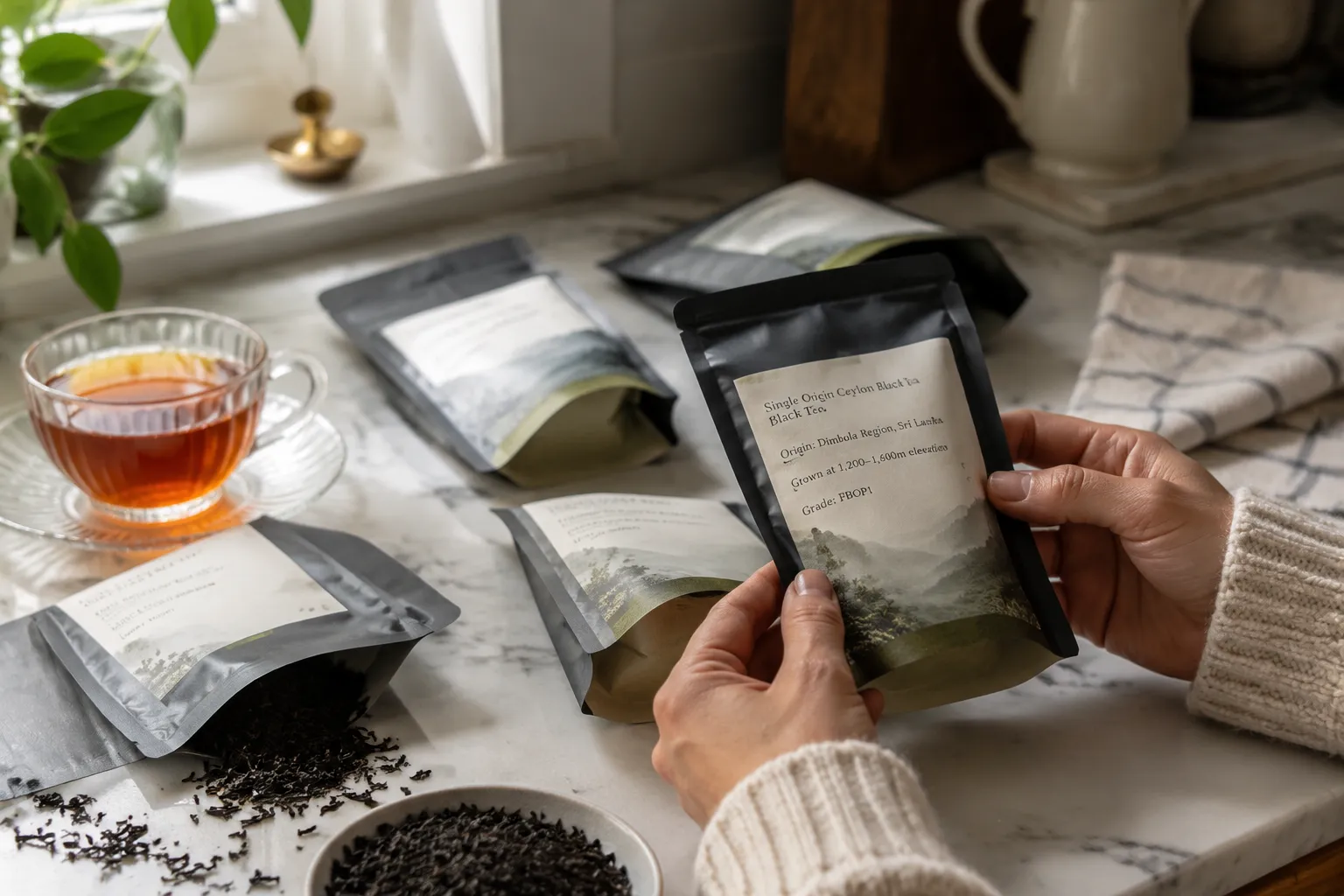
A Ceylon tea label is easiest to read in layers: origin wording first, then the Lion Logo if it appears, then region or district, elevation, and grade abbreviation. That order keeps the label useful without making it carry more meaning than it can.
If you want to know how to read Ceylon tea labels, start by treating “Ceylon” or “Sri Lanka” as the origin cue. Read “high-grown,” “mid-grown,” or “low-grown” as an elevation clue. Read OP, BOP, FBOP, fannings, or dust as leaf-form information. Together, those terms can suggest likely body, briskness, steeping speed, and leaf appearance. They do not guarantee flavor or overall quality.
upward
Start with the broader guide
Use the broader guide first if you need the full scope before this page.
Start with origin wording and the Lion Logo
“Ceylon tea” usually points to tea from Sri Lanka, using the older country name that remains attached to the tea trade. On a packet or product listing, you may see “Ceylon,” “Sri Lankan black tea,” “Pure Ceylon Tea,” or a more detailed estate, district, or regional description. Those phrases are the first layer of the label, but they do not all say the same thing.
The Ceylon tea Lion Logo is a separate cue from ordinary origin wording. Sri Lanka Tea Board material describes the Lion Logo as a controlled mark connected with tea packed in Sri Lanka under its stated conditions. For a shopper, the practical point is simple: do not treat the word “Ceylon” and the Lion Logo as the same evidence.
A label that says only “Ceylon black tea” gives a broad origin. A label that says “Ceylon black tea, Uva, BOP” or “Nuwara Eliya, high-grown, OP” gives more to work with: a place cue, an elevation clue, and a manufactured leaf style.
Keep origin separate from promise. Origin wording helps locate the tea. It does not prove that the cup will be bright, malty, delicate, strong, or smooth. Region, elevation, grade, harvest, blending, freshness, storage, water, ratio, and steep time all shape what lands in the cup.
Read Region and Elevation as Expectations, Not Rules
Ceylon tea region and elevation often appear together, but they are different clues. A region or district name tells you where the tea is associated geographically. An elevation term tells you the broad height band where the tea was grown. Both can guide buying expectations; neither is a flavor guarantee.
Those descriptions are useful when comparing two unfamiliar packets. A high-grown OP and a low-grown BOP are likely to behave differently in the pot. Still, elevation is only one part of the cup. A broken high-grown tea may brew more assertively than a whole-leaf low-grown tea at the same steeping time. A fresh, well-stored mid-grown tea may taste clearer than an older packet with a more famous region name.
Region names can appear as buying cues too. Ceylon tea labels may mention Nuwara Eliya, Dimbula, Uva, Uda Pussellawa, Kandy, Ruhuna, or Sabaragamuwa. Some are commonly associated with high-grown, mid-grown, or low-grown production, but a label does not always explain that relationship cleanly. If the label gives both region and elevation, read both. If it gives only one, avoid filling in the rest with certainty.
For a brisk, fragrant morning cup, a high-grown label may be worth trying. For deeper liquor that can stand up to milk, a low-grown or broken-grade label may point in that direction. For a middle path, mid-grown teas are often described in more rounded terms. Taste still has the final vote.
Decode Grade Abbreviations by Leaf Size and Manufacture
Sri Lankan tea grades can look like a quality code, but they are mainly leaf-form terms. Grade names describe the manufactured leaf’s size, wholeness, and appearance more directly than they describe how good the tea is. A long, wiry whole-leaf tea and a small broken tea can both be well made; they will brew differently.
OP
Orange Pekoe, commonly a whole-leaf grade. Larger leaf; often needs a little more time than smaller grades.
OPA / OP1
Whole-leaf styles with larger or more open leaf appearance. Watch the leaf size and adjust by taste.
BOP
Broken Orange Pekoe. Smaller broken leaf; often extracts faster and gives a brisker cup.
FBOP
Flowery Broken Orange Pekoe. Broken grade with appearance or tip distinctions depending on the tea.
FOP
Flowery Orange Pekoe. Whole-leaf grade with “flowery” grade language.
TGFOP / TGFOP1
Tippy Golden Flowery Orange Pekoe variants. Detailed appearance terminology, not a simple quality ranking.
BOPF
Broken Orange Pekoe Fannings. Smaller particles; quick extraction, common in strong infusions.
Fannings and Dust
Small to very small leaf particles. Fast brewing; dust extracts very quickly and can become rough if steeped too long.
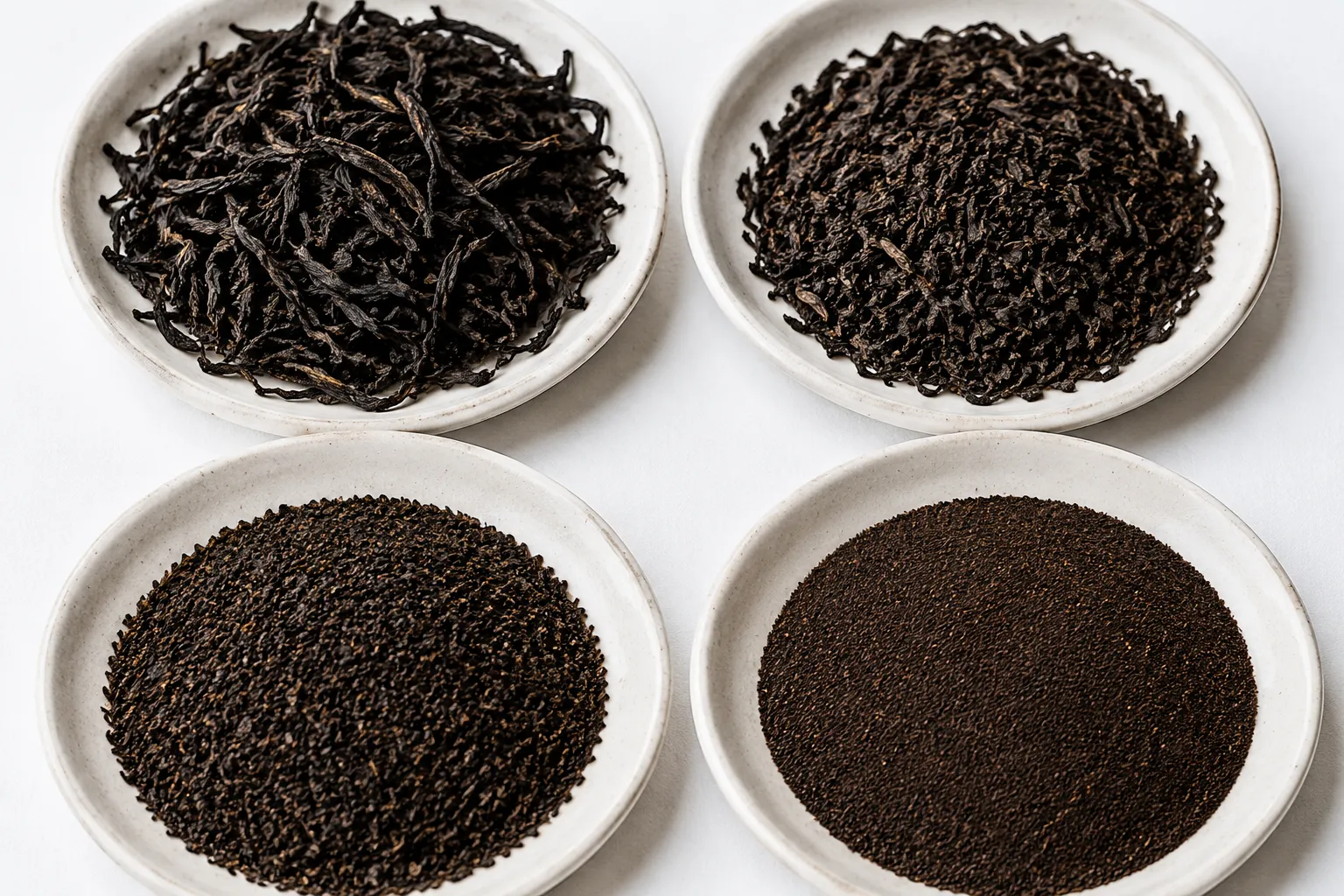
OP, BOP, and FBOP are especially common Ceylon tea grade abbreviations. OP suggests a larger, more intact leaf. BOP tells you the leaf has been broken into smaller pieces. FBOP adds another grade distinction, often connected with appearance and tip content, but it still belongs to the leaf-form system rather than a universal ranking system.
Smaller grades expose more surface area to water. That is why BOPF, fannings, and dust can brew quickly and produce a strong, dark, brisk cup at a steeping time that might be gentle for whole leaf. This can be useful for black tea with milk or for a short, forceful infusion. It is less useful if you want a slower cup built around aroma and gradual extraction.
Whole-leaf grades such as OP, OPA, OP1, FOP, or TGFOP often give you more visible leaf structure. They may need a slightly longer steep or a higher leaf-to-water ratio, depending on the cup you want. They are not automatically better; they give you a different brewing path.
Turn the Label into a First Brew
Once you have read the origin, region, elevation, and grade, use the label to choose a starting method rather than a final judgment.
High-grown whole leaf
Start with freshly boiled water, a moderate leaf amount, and a steep around 3 minutes. Taste before extending the time. If the tea is fragrant but thin, add a little more leaf next time before pushing the steep too far.
Mid-grown OP or BOP
Expect more middle weight. A whole-leaf grade may need time to open; a broken grade may show body sooner. If the cup feels flat, check freshness and storage before deciding the region is not for you.
Low-grown BOP, FBOP, or BOPF
Expect more depth and faster extraction. Start slightly shorter if you are sensitive to astringency. If you take milk, these grades may give enough strength without needing a long steep.
Fannings and dust
Treat time as the main control. These small particles can move from brisk to coarse quickly. Tea bags using fannings or dust are often built for convenience and strength, not for the same leaf display you would expect from loose OP.
This is where Ceylon tea label limitations matter. The label can help you choose a starting brew; it cannot replace tasting. Water hardness, kettle temperature, mug size, storage, age of the tea, and preference can change the result more than a single grade abbreviation suggests.
Common Label Confusions
Grade is not a medal
It is a manufactured leaf description. “Premium,” “luxury,” “finest,” and similar product-listing words may appear near grade abbreviations, but they are market language unless the seller explains exactly what is being compared. A BOP can be the right choice for a strong breakfast cup. An OP can be the right choice for a slower, clearer infusion.
Region and elevation are not the same clue
Region points to geography; elevation points to height band. Both are useful, but neither gives a complete sensory profile.
The Lion Logo is narrower than ordinary Ceylon wording
If that distinction matters to your purchase, look for the mark itself and read the rest of the package carefully.
Flavor shorthand is only a starting point
High-grown teas are often described in brighter and more fragrant language; low-grown teas often in darker, fuller, bolder language. Estate practice, harvest season, blending, storage, and brewing ratio can bend the cup away from that shorthand.
A Quick Way to Read the Next Packet
When you pick up a Ceylon tea label, read it in this order:
- Origin wording: Does it say Ceylon, Sri Lanka, or Pure Ceylon Tea?
- Lion Logo: Is the mark present, or is the package only using origin language?
- Region or district: Does it name Nuwara Eliya, Dimbula, Uva, Kandy, Ruhuna, Sabaragamuwa, Uda Pussellawa, or another place cue?
- Elevation: Does it say high-grown, mid-grown, or low-grown?
- Grade: Does it show OP, BOP, FBOP, BOPF, Pekoe, fannings, dust, or another abbreviation?
- Brewing adjustment: Is the leaf whole, broken, or very small, and should you shorten or lengthen the steep?
That sequence keeps the label practical. Use origin and mark language to understand what the package is claiming. Use region and elevation to set a broad expectation. Use grade to adjust steeping speed and strength. Then taste the cup before deciding whether that Ceylon black tea belongs in your regular rotation.
Sources
Sources and further reading
Reference links are limited to sources considered suitable for public citation in this page.