Brewing tool choice
Tea Strainer vs Infuser Basket for Western Black Tea
For most Western black tea drinkers, the choice is practical: use a wide infuser basket for one mug, and use a loose leaf tea strainer when brewing loose leaves in a teapot.
The difference is not that one tool makes better black tea. It is when the tool works. An infuser basket holds the leaves during steeping and can be lifted out when the cup is ready. A tea strainer catches the leaves after they have steeped loose, usually as you pour from a pot into a cup.
Useful answer
- Choose a black tea infuser basket when you want one controlled mug, easy removal, and simple cleanup.
- Choose a loose leaf tea strainer when you want leaves to steep freely in a teapot and you plan to pour the tea off the leaves on time.
- For broken black tea, breakfast blends, and CTC-style teas, mesh fineness often matters more than the tool category.
- For larger orthodox black tea leaves, space matters more than decorative shape.
upward
Start with the broader guide
Use the broader guide first if you need the full scope before this page.
The quick decision rule
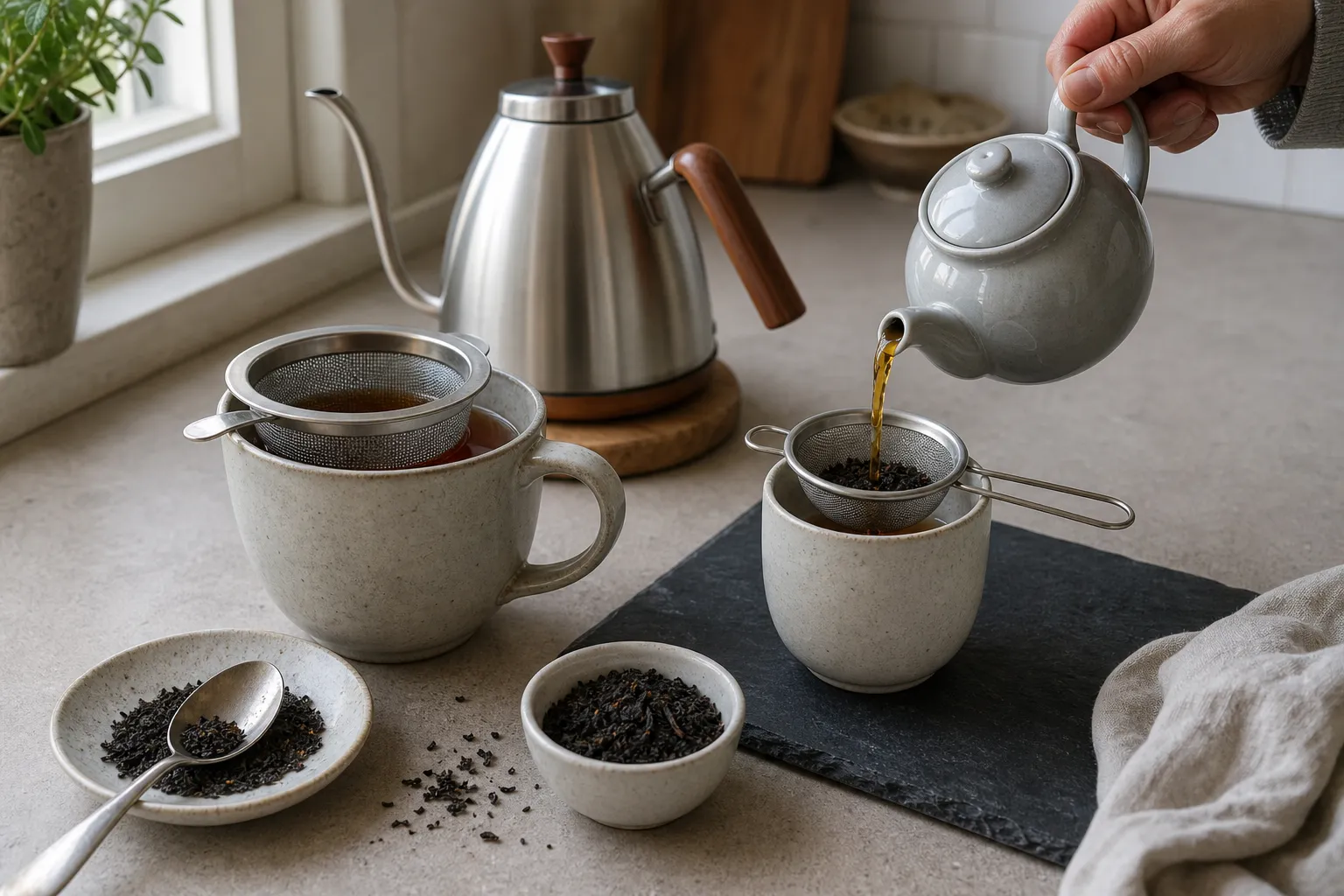
If you are making one mug of English Breakfast, Assam, Ceylon, Keemun, Darjeeling, or another Western-style black tea, a wide infuser basket is usually the easier tool. It should sit low enough for the leaves to be fully covered, with enough width that the tea is not packed into a tight mound. When the steep is done, you lift out the basket and stop the brew.
If you are making a teapot for two or more cups, a tea strainer often fits the rhythm better. The leaves steep loose in the pot, then the strainer sits over each cup as you pour. This gives the leaves plenty of room, especially for larger leaf styles.
The catch is timing. A strainer catches leaves; it does not stop extraction while tea and leaves remain together in the pot. If the first cup is poured and the rest sits with the leaves, later cups may become darker, stronger, brisker, or more astringent. If you want loose teapot brewing with tighter control, pour all the tea into cups or into a second warmed pot once the steep tastes right.
How the workflow changes the cup
An infuser basket is a brewing tool. You put the tea in the basket, place it in the mug or pot, add hot water, steep, and remove the basket. That makes timing visible and repeatable. If a black tea tastes thin at three minutes and too sharp at five, you can adjust the next mug by half a minute without changing the whole setup.
A strainer is a pouring tool. The tea brews loose in the teapot, and the strainer keeps most leaves out of the cup as you pour. This works well when you want open leaf movement and a traditional Western teapot service. It works less well if the pot sits half full with leaves still inside.
This is also why “tea basket vs tea ball” is a different question. A tea ball is an infuser, but often a cramped one. A wide basket usually gives black tea leaves more space than a small ball, egg-shaped infuser, or narrow chain infuser.
What black tea leaves need from the tool
Black tea extraction is shaped by leaf size, water temperature, tea-to-water ratio, steep time, movement, and the brewing vessel. The available research does not give a universal ranking of strainers against baskets for Western black tea. It does support the more modest point that utensils, steeping method, particle size, and infusion time can influence the finished liquor.
At the kettle, that translates into a few useful checks.
Space helps larger leaves hydrate evenly.
Whole-leaf and larger broken-leaf black teas expand as they steep. If a basket is too small or overfilled, the leaves can sit in a compressed clump. Water still reaches them, but circulation is reduced. A roomier basket or loose teapot brew is usually more forgiving.
Loose teapot brewing gives the most open movement.
Leaves can spread through the pot instead of pressing against mesh. This can suit many orthodox black teas, provided you pour on time or decant the brewed tea away from the leaves.
Fine mesh matters for small particles.
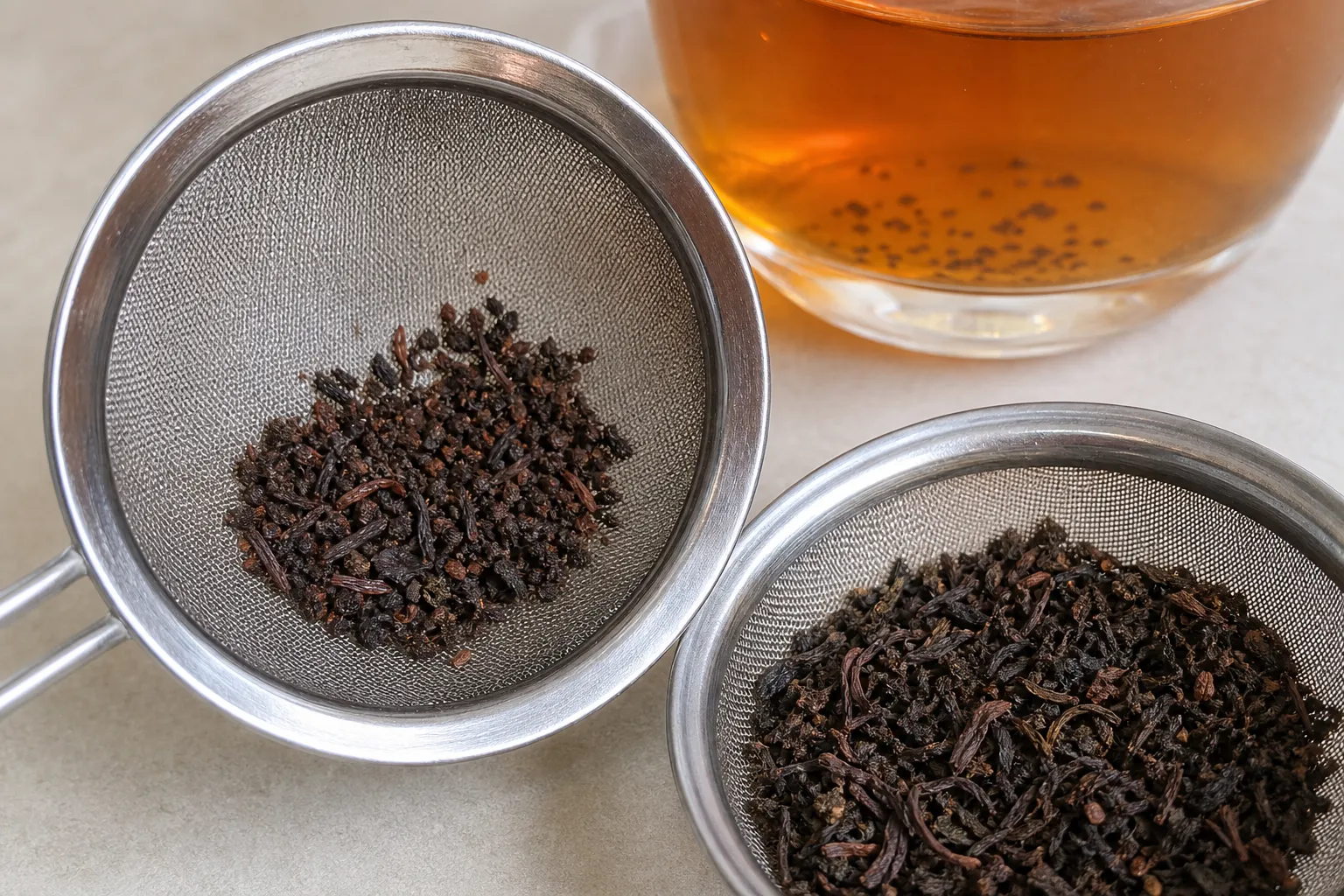
Many Western black teas are not large-leaf teas. Breakfast blends and CTC-style teas often include small pieces and dust. A coarse decorative strainer may let those particles through, leaving sediment or grit at the bottom of the cup. A fine mesh tea strainer or basket will not make a dusty tea perfectly clear, but it can reduce leaf bits in the liquor.
Cleanup may decide the everyday choice.
A basket keeps wet leaves contained, so it is easy to empty and rinse. Loose leaves in a teapot may cling to the spout, lid, and walls. For a desk mug, the basket is usually simpler. For a slower pot at home, the extra rinse may be worth the open steep.
Match the tool to common Western black tea situations
One mug before work
Wide infuser basket
Easy timing, easy removal, less mess.
Small teapot for two cups
Either
Basket gives control; loose leaves plus strainer gives more open movement.
Teapot poured immediately
Loose leaf tea strainer
Leaves steep freely, and the pot is emptied before timing drifts much.
Larger orthodox black tea
Roomy basket or loose teapot brew
Leaves need space to hydrate and separate.
Broken black tea or CTC-style tea
Fine mesh basket or fine mesh strainer
Helps reduce sediment and leaf flecks.
Strong tea for milk
Basket or timed teapot method
Milk softens the perception of briskness, but timing still shapes strength and astringency.
Office or travel mug
Basket with lid or rest
Easier containment; avoid designs that leave leaves sitting in water indefinitely.
Practical method notes
- Use enough space. If dry leaves already press hard against the mesh, the tool is probably too small for that dose.
- Check timing before blaming the tool. A harsh cup may be over-steeped, over-dosed, or made with very small particles. A flat cup may need more leaf, hotter water, a longer steep, or fresher tea.
- Stop the steep deliberately. With a basket, lift it out. With loose leaves in a teapot, pour the tea off the leaves if you want the cup character to hold steady.
- Choose mesh for the tea you actually drink. Large leaves can work with many strainers and baskets. Broken black tea and dusty blends call for finer mesh if you dislike sediment.
- Rinse before leaves dry. Fine mesh catches small particles, so rinse from the reverse side. A teapot used with loose leaves may need a quick swirl of water to clear the spout.
Common confusion: strainer, basket, and tea ball
A strainer and an infuser are not just two names for the same object. They both separate leaf from liquor, but they do it at different moments. The infuser sits in the water while the tea brews. The strainer waits until pouring.
An infuser basket is not the same as a tea ball in practice. Both hold leaves during steeping, but a basket is usually wider and more open. A tea ball can be convenient for small leaves and casual brewing, but it is easy to overfill. For many loose black teas, a basket is the more forgiving infuser shape.
A strainer is not inferior because it looks old-fashioned. For teapot brewing, it solves a real problem: the leaves can steep freely, and the cup can stay mostly leaf-free. Its weakness is timing control, not brewing quality.
Where the answer stops
There is no strong direct consumer test showing that a tea strainer is always better than an infuser basket, or the reverse, for Western black tea. The more useful conclusion is conditional.
Use a wide infuser basket when you want one controlled mug with easy cleanup. Use a loose leaf tea strainer when you want loose leaves in a teapot and are ready to pour on time. For broken black tea, prioritize fine mesh. For larger leaves, prioritize room. For black tea strength and astringency, timing usually matters more than the tool itself.
FAQ
Is a tea strainer better than an infuser basket for black tea?
Not automatically. A strainer is better for loose teapot brewing when you pour promptly. An infuser basket is better for one mug or any situation where you want to lift the leaves out at a set time.
Can I use an infuser basket in a teapot?
Yes, if the basket is large enough for the teapot and the tea dose. A small mug basket in a large pot may crowd the leaves or sit too high in the water.
Why does my black tea taste stronger from a teapot?
If the leaves remain in the pot after the first cup is poured, the remaining tea keeps extracting. That can make later cups stronger, darker, and more astringent.
Do I need fine mesh for black tea?
You need fine mesh if you drink small-cut black tea, breakfast blends, or CTC-style tea and dislike sediment. Larger leaf black teas are usually less demanding.
Is a tea ball good for Western black tea?
It can work for small amounts, but it is easy to overfill. For most loose black teas, a wide infuser basket gives the leaves more usable space.
Sources
Sources and further reading
Reference links are limited to sources considered suitable for public citation in this page.