Black tea troubleshooting
Why Black Tea Tastes Bitter, Weak, or Astringent
A disappointing cup of black tea is easier to fix once you stop treating “bad” as one flavor. The problem might be sharp bitterness on the tongue, a dry puckering mouthfeel, a thin body, a flat aroma, or a sour or metallic edge that has more to do with water than tea.
The practical answer to why black tea tastes bitter weak or astringent usually sits in a small group of variables: leaf amount, leaf size, steeping time, water temperature, freshness, storage, water taste, and the style of black tea you expected in the first place.
Start with the cup in front of you, not with a universal rule.
upward
Start with the broader guide
Use the broader guide first if you need the full scope before this page.
Bitter, Weak, and Astringent Are Different Problems
Many tea drinkers use “bitter” for any unpleasant black tea, but the fix changes depending on what you are actually tasting.
Bitterness is a flavor. It shows up on the tongue as a sharp, harsh, sometimes biting taste. In black tea, bitterness feels more obvious when the cup has little aroma, little natural sweetness, or not enough body to balance the edge.
Astringency is mostly mouthfeel. Astringent black tea makes the mouth feel dry, tight, rough, or puckery, often along the gums, cheeks, and back of the tongue. A cup can be astringent without tasting sharply bitter. Some black teas are meant to have a brisk, drying finish; the issue is when that dryness takes over.
Weakness is about concentration and presence. Weak black tea may look pale, but it can also look dark and still taste watery. It may lack aroma, maltiness, brightness, body, or a satisfying finish. A longer steep does not always solve this, because extra time can bring more harshness without restoring body or aroma.
Flatness is different again. A flat cup may not be bitter or dry. It simply lacks lift. It can taste dull, stale, papery, muted, or empty, which points more toward freshness, storage, water, or the tea’s natural style.
A practical first diagnosis
Sharp bitterness after a long steep
May point toward too much extraction for that tea, small broken leaf, or a naturally assertive style. First try shortening the infusion before changing everything.
Dry, puckery mouthfeel
May point toward astringency more than pure bitterness. First try reducing steeping intensity or choosing a rounder tea.
Pale color and thin body
May point toward too little leaf, too much water, large leaf needing more time, or a weak later infusion. First try more leaf or less water before steeping much longer.
Dark color but watery taste
May mean color extracted faster than aroma and body, or that the tea is low in aroma. Adjust ratio and check freshness; do not judge by color alone.
Dull, stale, papery aroma
May point toward old tea or poor storage. Try fresher tea or review storage.
Sour, metallic, or sharply mineral edge
May point toward water, kettle residue, cup residue, or tea condition. Taste the water plain and clean the brewing gear.
This is not a lab diagnosis. It is a practical tasting map for the next cup.
Why Black Tea Tastes Bitter Even When You Follow the Directions
Package directions are broad. They do not know your mug size, your water, your leaf shape, your preference, or how long the tea has been open. A steep that works for one black tea can make another taste harsh.
Black tea bitterness often comes from too much intensity for the cup you want. That intensity can come from a long infusion, very hot water, a high leaf-to-water ratio, or small broken leaves that infuse quickly. These variables work together. A generous spoonful of fine tea in a small mug can become forceful much faster than large leaf in a roomy pot.
If your black tea tastes bitter even when you follow the directions, change one variable at a time:
- Shorten the steep slightly. If the bitterness drops but the tea still has body, time was likely part of the problem.
- Use a little less leaf. If the cup becomes cleaner without turning hollow, the original ratio may have been too strong for your taste.
- Keep the leaf amount but use more water. This tests whether concentration, not time, was the issue.
- Try slightly cooler water for delicate or harsh-tasting teas. Some black teas handle fully boiling water well; others taste rougher at maximum intensity.
- Taste before the suggested time is up. You can always let tea steep longer, but you cannot remove bitterness once it dominates the cup.
Directions are a starting point. The cup is the better guide.
Bitter vs Astringent Black Tea: How to Tell the Difference
The easiest way to separate bitter vs astringent black tea is to notice what happens after you swallow.
If the problem is mainly bitterness, the unpleasant impression is flavor-led. It may remind you of burnt edges, overcooked greens, harsh herbs, or a sharp bite on the tongue. The aftertaste lingers as a bitter note.
If the problem is mainly astringency, the impression is texture-led. Your mouth feels dry or grippy. Your cheeks may tighten. The tea may seem to pull moisture from the mouth, even when the flavor itself is not especially bitter.
This distinction matters because some astringency belongs in black tea. It gives structure, briskness, and a clean finish, especially in teas commonly taken with milk or food. A completely soft black tea is not automatically better. But when dryness becomes the main event, the tea stops tasting full and starts tasting severe.
Quick check
- Sip once and notice the first flavor on the tongue.
- Swallow and wait a few seconds.
- Ask whether the main problem is a bitter taste, a dry mouthfeel, or both.
- Smell the empty cup or wet leaves if you can. Pleasant aroma with harsh mouthfeel often points toward over-steeping rather than staleness.
- If the aroma is dull and the mouthfeel is sharp, freshness or storage may be involved.
A dry puckery black tea is not always a bad tea. It may simply be brewed in a way that emphasizes briskness more than aroma, sweetness, or body.
Why Black Tea Tastes Weak Even After a Long Steep
A longer steep is not always the answer to weak black tea. Sometimes it creates the worst version of the cup: thin in body, but harsh in finish.
“Strength” has several parts:
- Color: how dark the liquor looks.
- Aroma: what rises from the cup.
- Body: how full or thin the tea feels.
- Flavor: malt, fruit, toast, spice, earth, brightness, or other notes depending on the tea.
- Finish: what remains after swallowing.
A dark colored weak tea is possible because color does not always equal flavor. Some teas release color quickly but still taste watery if there is too little leaf, too much water, old tea, or little aroma left in the leaf. Judging only by color can make you stop too early or steep too long for the wrong reason.
When black tea tastes watery even though the color looks dark, start with ratio rather than time. Use a bit more leaf, reduce the water volume, or choose a smaller cup. If that helps, the tea did not need more minutes; it needed a stronger starting point.
If the tea tastes weak after a long steep and also feels dry, the leaf may already have given much of what you wanted and is now giving more roughness than flavor. This can happen with a tired second infusion, a tea bag that extracted quickly in the first cup, or old tea that no longer has much aroma to offer.
Re-steeping varies by tea. Some whole-leaf black teas can give a pleasant later infusion, while others fade quickly. A re-steeped black tea tastes weak, bitter, or empty when the second cup has less aroma and body but still enough drying edge to feel rough. At that point, shorter later steeps may not restore the first cup; the leaf may simply be spent.
Leaf Form Changes How Fast the Cup Turns
Leaf form is one reason tea bags can make black tea taste bitter faster than loose leaf, though it is not a universal rule. Tea bags often contain smaller pieces than many loose-leaf teas. Smaller pieces expose more surface area to water, so the cup can become dark and strong quickly. That is useful for a fast breakfast-style cup, but it also gives you less room before the tea turns harsh.
Loose leaf is not automatically gentle. Some loose teas are small, broken, or tightly processed. Some tea bags are blended to taste balanced with milk. The point is not “bag bad, loose good.” The point is that leaf size and structure change timing.
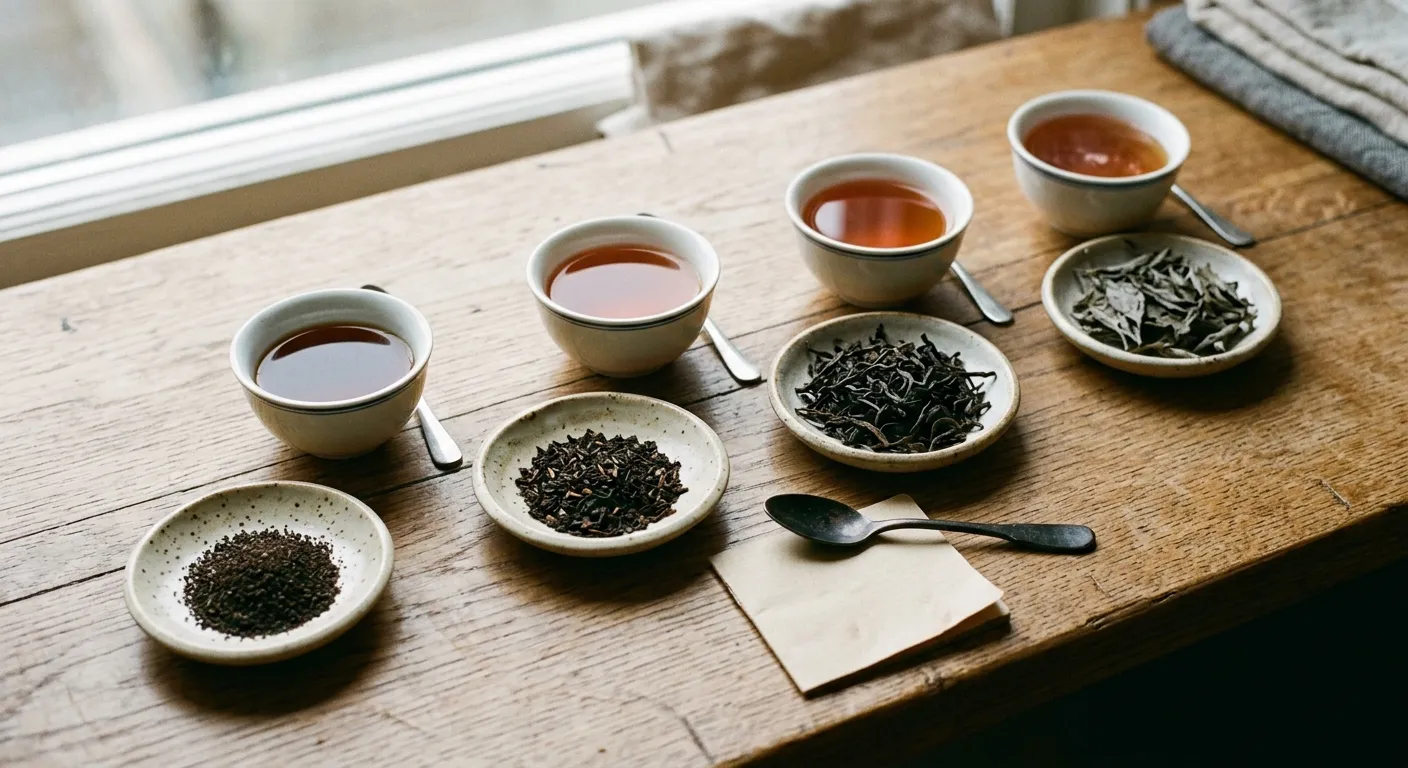
Look at the dry tea or spent leaves:
- Fine particles or dust-like pieces usually brew quickly and can become forceful fast.
- Small broken leaves often produce strong color and briskness in a short time.
- Larger twisted or whole leaves may need more room and time to open, and may taste thin if under-leafed.
- Very old or poorly stored leaf may look normal but smell faded, papery, or flat.
Can too much tea leaf make black tea bitter, or just stronger? It can do either. More leaf can give more body, aroma, and satisfying strength. But if the tea is already sharp, broken, stale, or brewed too long, more leaf can intensify bitterness and astringency too.
Use a sensory rule instead of a rigid measurement: if the cup is weak but pleasant, add leaf. If the cup is weak and harsh, shorten or soften the brew before adding more.
When Boiling Water Is the Suspect, and When It Is Not
Many black tea instructions call for very hot or boiling water. That does not mean boiling water is always the cause of bitterness, and it does not mean it never matters.
For sturdy breakfast blends, strong broken-leaf teas, or teas intended to stand up to milk, very hot water may produce the expected brisk cup. For more aromatic or delicate black teas, the same approach may make the cup taste sharper than you want. Style matters, and so do mug size, leaf quantity, and steeping time.
If you suspect boiling water is making black tea bitter, run a simple comparison:
- Brew one cup as usual.
- Brew another with the same leaf amount and steeping time, but let the water cool briefly before pouring.
- Compare aroma, body, bitterness, and mouthfeel.
If the cooler cup tastes rounder but still flavorful, water temperature was probably contributing. If it tastes flat and thin, the original heat may have been helping the tea express itself. If both cups taste stale or metallic, temperature was probably not the main issue.
Water itself can also change the cup. If black tea tastes sour, metallic, or bitter from the water, the clue is often present before brewing. Taste the water plain. Smell the empty kettle. Rinse the cup. Residue, old water, strong mineral taste, or a tainted vessel can make decent tea seem wrong. Without a clean-tasting base, small brewing adjustments may not fix the problem.
Why Black Tea Tastes Flat Instead of Malty, Bright, or Aromatic
A flat cup asks a different question from a bitter one. It is less about harshness and more about absence.
Black tea tastes flat when the aroma is muted, the body is thin, or the finish disappears quickly. It may lack the malty, bright, fruity, floral, woody, or toasty notes you expected from the package description. Several things can cause that gap.
The tea may be old or poorly stored. Old black tea can taste weak, stale, or sharply bitter because the pleasant aromatic parts have faded while rough edges remain. Storage does not have to be dramatic to matter. A loose tin left open, a paper packet near spices, a bag stored in sunlight, or tea kept near heat can all make the cup less lively.
The tea may not match the description in your mind. “Black tea” covers many styles. Some are brisk and direct. Some are soft and honeyed. Some are smoky, earthy, fruity, floral, or malty. A tea that is not naturally aromatic will not become bright just because it steeps longer.
The ratio may be too low. A tea can be fresh but underpowered if there is too much water for the amount of leaf.
The brewing vessel may be crowding the leaf. Larger leaves need space. A cramped infuser can leave parts of the leaf under-exposed while the outer surfaces over-brew. The result can be oddly thin and rough at the same time.
To diagnose flatness, smell before you adjust. Smell the dry leaf, then the wet leaf, then the brewed cup. If the dry leaf has little aroma and the wet leaf smells dull, freshness or tea quality may be the main limit. If the wet leaf smells good but the cup tastes watery, the issue may be ratio, vessel, or steeping time.
A Practical Troubleshooting Path for the Next Cup
If the tea is bitter but full
Keep the same leaf amount and shorten the infusion. If it still tastes too sharp, try slightly cooler water or a rounder tea style. If you drink it plain, a splash of milk or food alongside it may change how the bitterness reads, but that is a preference choice rather than a fix.
If the tea is dry and puckery
Treat it as an astringency problem. Shorten the steep, reduce the leaf slightly, or avoid squeezing the tea bag hard against the cup. If the dryness is part of the tea’s character, you may prefer it with milk, with food, or brewed lighter.
If the tea is weak and pale
Use more leaf, less water, or a longer steep, in that order if the flavor is otherwise clean. Pale and pleasant usually means the brew can be strengthened.
If the tea is dark but watery
Do not assume it needs more time. Try more leaf or a smaller cup. Check whether the tea smells fresh. A dark cup without aroma often points away from steeping time alone.
If the tea is weak and bitter
This is the frustrating middle ground. The tea may be over-steeped but under-bodied, stale, too finely broken, or brewed with water that makes it taste harsh. Shorten the steep and increase leaf slightly only if the shorter cup becomes cleaner. If it stays hollow, the tea itself may be the limiting factor.
If the tea is sour, metallic, or oddly sharp
Check the water and equipment before blaming the tea. Brew with fresh water in a clean vessel. If the strange note disappears, the cause was outside the leaf. If it remains, the tea may be stale, affected by storage odors, or simply not to your taste.
What Not to Overread From One Bad Cup
One poor mug does not prove that you dislike black tea, that all tea bags are harsh, that boiling water is wrong, or that loose leaf always needs a long steep. Black tea is broad, and the same method can flatter one tea while flattening another.
The most common mix-ups are:
- Mistaking astringency for bitterness. Dryness in the mouth is not the same as a bitter flavor.
- Using color as the only strength marker. Dark tea can still be thin.
- Trying to fix weak tea only with time. More time can increase roughness before it increases body.
- Expecting old tea to brew like fresh tea. A faded leaf may not recover its aroma.
- Ignoring water and cups. Off flavors can come from the brewing environment.
- Treating package directions as exact. They are a starting point, not a personal calibration.
The most useful habit is to name what is wrong before you adjust. Is it bitter? Dry? Thin? Flat? Sour? Metallic? Once you can separate flavor, mouthfeel, aroma, and body, practical black tea troubleshooting becomes much easier.
A Simple Decision Frame
For your next cup, use this sequence:
- Smell the dry leaf. If it smells stale, dusty, or faint, manage expectations before brewing.
- Check the leaf form. Fine particles and small broken leaves usually need closer timing than large leaves.
- Choose the ratio deliberately. More leaf makes sense for clean but weak tea; it may worsen harsh tea.
- Taste before the steep goes too far. Stop when aroma and body are present, not when the cup reaches maximum darkness.
- Separate bitterness from astringency. Flavor and mouthfeel point to different adjustments.
- Question the water if the taste is sour, metallic, or strange.
- Change one variable at a time. Otherwise, you will not know what helped.
Black tea should not taste identical across every style. Some cups are brisk and drying; others are soft, malty, fragrant, or strong enough for milk. The goal is not to remove every edge. It is to understand which edge belongs to the tea, which one came from brewing, and which one tells you the leaf, water, or storage is working against the cup.