Label reading guide
How to Read Chinese Black Tea Labels for Keemun, Dianhong, and Lapsang
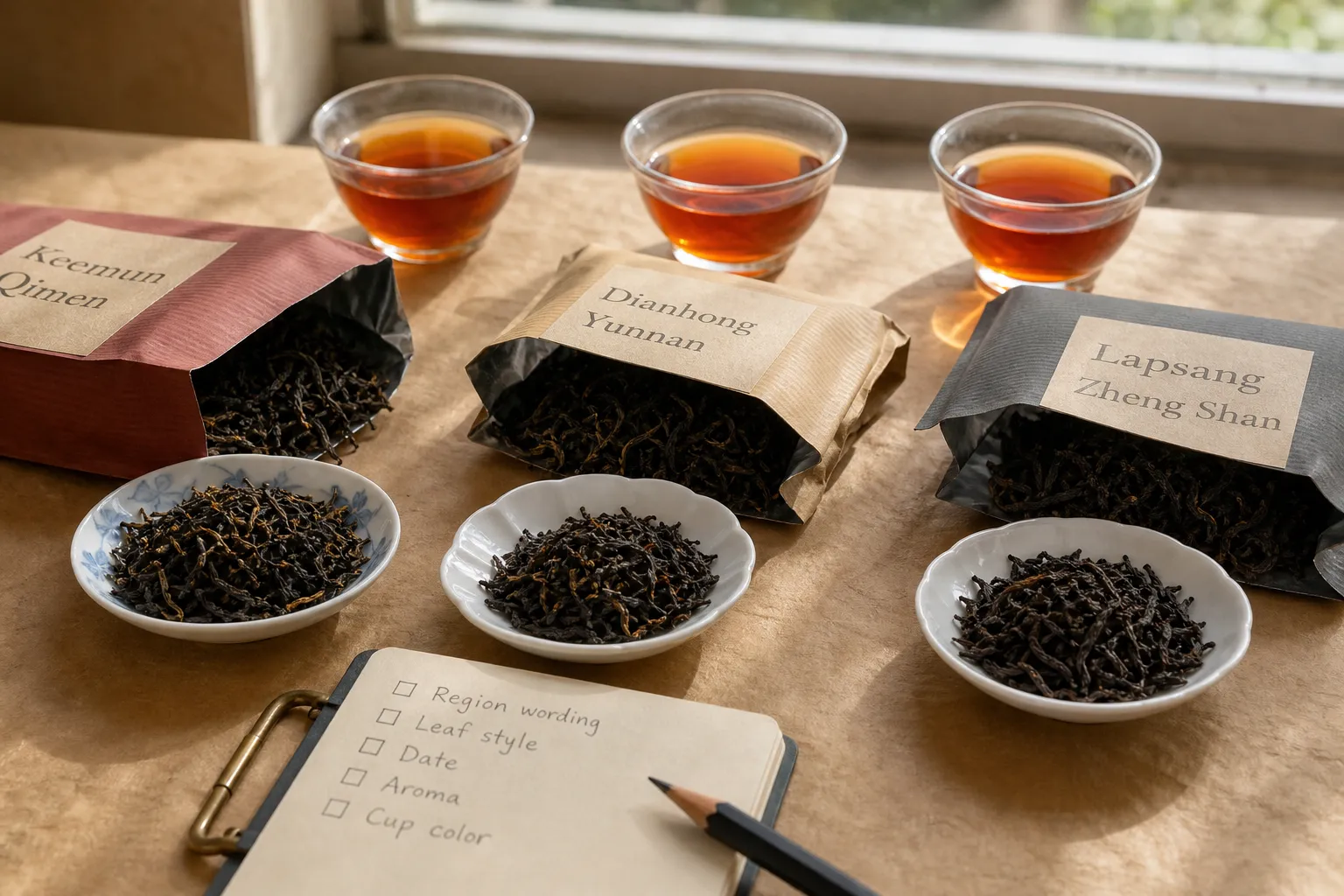
A good Chinese black tea label is a set of clues, not a final judgment. Start with the name family: Keemun may also appear as Qimen or Qi Men; Dianhong may appear as Dian Hong, Yunnan black tea, or Yunnan Gold; Lapsang Souchong may sit beside Zheng Shan Xiao Zhong, Tongmu, Tong Mu, Wuyi, Fujian, smoked, or non-smoked. Then check what the package actually gives you: region wording, leaf-style terms, smoke language, packing date, storage protection, dry-leaf aroma, and brewing behavior.
Chinese black tea labels can point you toward a likely style. They cannot, by themselves, confirm grade, freshness, exact origin, careful storage, or cup quality.
upward
Read the full overview first
Use the broader guide first if you need the full scope before this page.
First Decode the Category: Black Tea, Red Tea, and Dark Tea
The first label confusion is often the color word. In English, Keemun, Dianhong, and Lapsang Souchong are usually discussed as black teas. In Chinese tea language, the same broad category is commonly called hong cha, often translated as “red tea.” The name refers more naturally to the reddish, amber, copper, or reddish-brown liquor than to the dark dry leaf.
That is different from Chinese dark tea. Dark tea usually points toward post-fermented tea categories, not the same shelf as Keemun, Dianhong, or Lapsang Souchong.
So if a package says hong cha, red tea, Keemun, Dianhong, or Lapsang Souchong, read it as Chinese black tea in the English buying sense. Then move on to the more useful details: name family, region, leaf style, smoke wording, date, and aroma.
The Three Label Families at a Glance
Use the label as a reading map before you decide by smell or cup color.
Keemun
Also look for: Qimen, Qi Men, Anhui, Mao Feng.
What it may suggest: A Keemun/Qimen name family, sometimes with a leaf-style cue.
What it does not prove: Grade, freshness, exact flavor, or careful storage.
Dianhong
Also look for: Dian Hong, Yunnan, Yunnan black tea, Yunnan Gold.
What it may suggest: A Yunnan black tea context, sometimes with golden-tip market wording.
What it does not prove: That “Gold” is automatically better or part of a fixed quality ladder.
Lapsang Souchong
Also look for: Zheng Shan Xiao Zhong, Tongmu, Tong Mu, Wuyi, Fujian, smoked, non-smoked.
What it may suggest: A Fujian/Wuyi/Tongmu-linked name family, with smoke wording especially important.
What it does not prove: That every seller uses the name in the same narrow way.
This is not a ranking. It is a way to slow the buying decision down. A label can name a style, but the cup still depends on harvest, processing, storage, brewing ratio, water, and steep time.
Reading a Keemun Tea Label
A Keemun tea label is often a transliteration puzzle before it is a tasting promise. Keemun, Qimen, and Qi Men can all point toward the same name family. Anhui may appear as the regional anchor. Mao Feng may appear as a style or leaf-form cue, especially when a seller wants to distinguish the tea from a more general Keemun listing.
That extra wording matters, but it should not be overread. Keemun Mao Feng may tell you how the seller is presenting the leaf, but it does not guarantee a smoother, fruitier, more aromatic, or higher-quality cup than another Keemun. Those descriptors are useful expectations, not proof.
For Keemun, compare the label with what you can observe. Does the dry leaf smell clean, sweet, lightly fruity, floral, woody, or stale? Does the liquor brew clear amber to reddish-brown, or does it look dull? Is the body brisk and fragrant, or thin and sharp? A Keemun name gets you to the right tasting neighborhood; the brewed tea tells you how this package behaves.
Good seller questions are modest: Which harvest or lot is this? Is Qimen or Anhui named more specifically anywhere on the package? What does Mao Feng mean in this listing? When was it packed? A useful answer does not need to be elaborate, but it should give more than flattering adjectives.
Keemun checks
- Match Keemun, Qimen, and Qi Men as one name family.
- Use Anhui as a regional anchor when it appears.
- Read Mao Feng as a presentation or leaf-form cue, not a guarantee.
- Judge the package against dry-leaf aroma, liquor clarity, body, and briskness.
Dianhong checks
- Group Dian Hong, Dianhong, Yunnan black tea, and Yunnan Gold together.
- Ask what the seller means by “Gold” before treating it as a quality claim.
- Compare golden tips, darker twisted leaves, and mixed leaf color with the cup.
- Keep brewing method steady so body, sweetness, briskness, and aroma are comparable.
Reading a Dianhong Label
A Dianhong label is usually easier to connect to region than to quality. Dian Hong, Dianhong, Yunnan black tea, and Yunnan Gold all belong to a recurring label cluster around Yunnan black tea. “Dian” is strongly associated with Yunnan naming in tea-market language, while English-language packages often simplify the idea into Yunnan black tea or Yunnan Gold.
The word “Gold” needs a careful read. It may point to visible golden tips or a golden-bud style presentation, and many buyers associate it with a rounder, sweeter cup. But gold wording is not a fixed quality ladder. It does not mean the tea is automatically better than a darker-leaf Dianhong, nor does it tell you how fresh, carefully processed, or well stored the tea is.
With Dianhong, look at the leaf and the first infusion. Golden tips, darker twisted leaves, and mixed leaf color can all appear. In the cup, buyers often look for body, sweetness, malt-like depth, fruitiness, briskness, or astringency, but those traits vary. A short, strong steep may feel full and brisk; a lighter ratio may show more aroma and softness.
The better question is not “Is this Yunnan Gold better?” It is “What does this seller mean by Yunnan Gold?” Ask whether the wording refers to leaf appearance, origin, harvest, or simply the product name. Then check packing date, aroma, and how the tea responds to your usual black tea brewing method.
Reading a Lapsang Souchong Label
A Lapsang Souchong label needs the closest attention because smoke wording changes the expected cup. Lapsang Souchong may appear beside Zheng Shan Xiao Zhong, Tongmu, Tong Mu, Wuyi, Fujian, smoked, non-smoked, pine smoke, or pine-smoked language. These terms overlap in the market, and sellers do not always use them with the same precision.
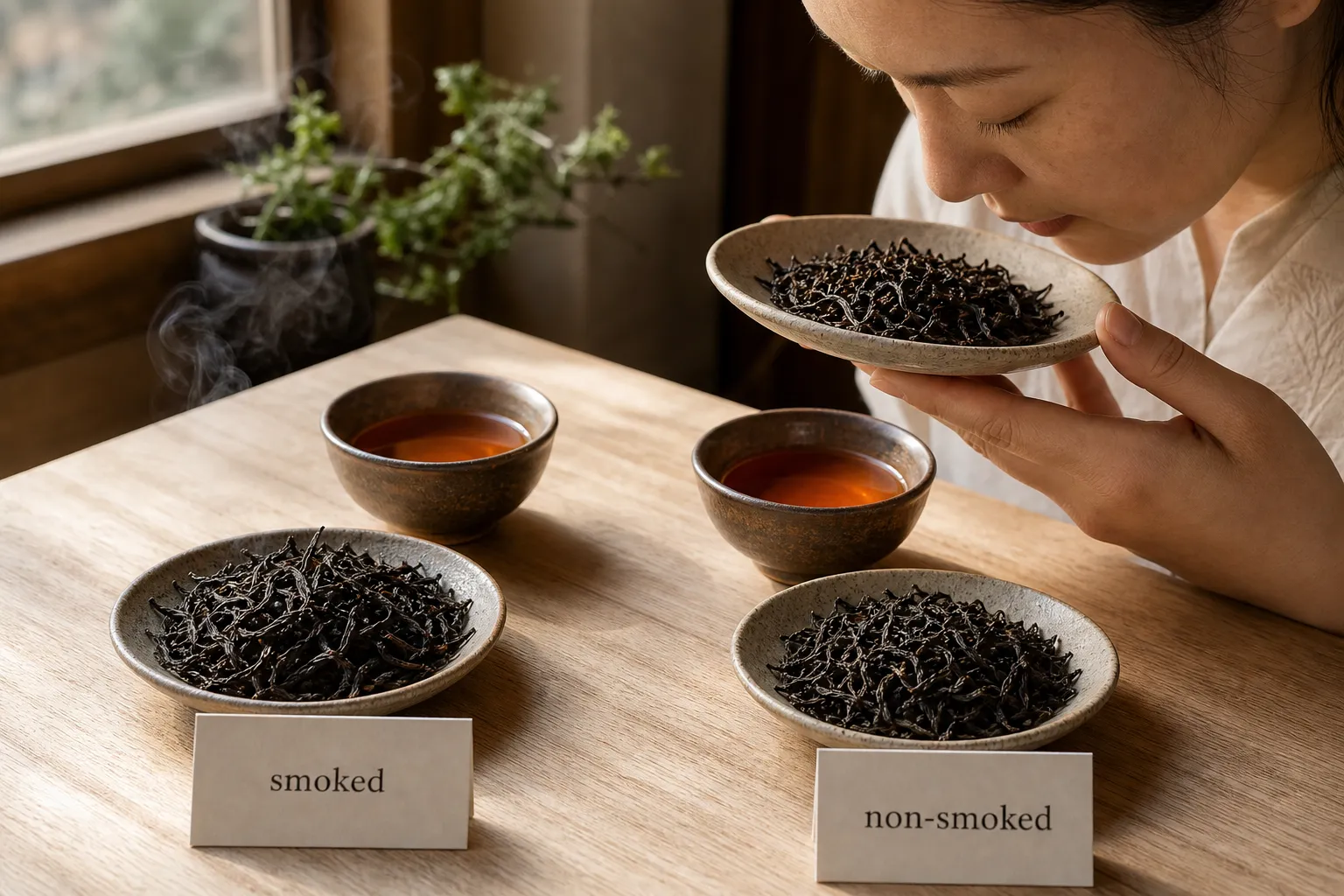
If the package says smoked Lapsang Souchong, expect smoke to be part of the aroma. It may read as piney, resinous, woody, sharp, mellow, or heavy depending on processing and storage. A PubMed-indexed aroma-chemistry record on smoked Lapsang Souchong supports the narrow point that pine smoking changes volatile aroma compounds. That helps explain why smoked and non-smoked wording matters, but it does not confirm any retail claim about origin, grade, storage, or overall quality.
If the package says non-smoked Lapsang Souchong, do not assume the label is wrong. Some sellers distinguish non-smoked versions from smoked versions, while others use stricter meanings for Zheng Shan Xiao Zhong, Tongmu, or Wuyi. Treat those words as origin and style signals to investigate, not as one universal rule.
For Lapsang, smell the dry leaf before brewing if possible. A smoked version may show clear pine smoke aroma before water touches it. A non-smoked version may lean more toward fruit, sweetness, wood, or warm aromatics. In the cup, smoke can dominate, sit in the background, or be nearly absent. The label gives the expectation; the aroma tells you how much smoke is actually present.
Package Details That Matter After the Name
Once you have decoded the name family, look for practical package cues. A packing date is useful because black tea aroma can fade with time and poor storage. A sealed inner bag, lined pouch, or other protective packaging can suggest attention to storage, though it is not a universal standard or proof of quality.
Read origin wording in clusters. Anhui, Qimen, and Keemun belong together. Yunnan, Dian Hong, and Yunnan Gold belong together. Fujian, Wuyi, Tongmu, Zheng Shan Xiao Zhong, and Lapsang Souchong belong to the Lapsang reading path. The more specific the label is, the more specific your follow-up question can be.
Be cautious with persuasion words. Premium, finest, original, rare, ancient, and similar terms may be part of how tea is sold, but they do less work than a clear product name, date, storage protection, leaf appearance, and brewing result. The same applies to wellness-style marketing. For this question, the useful issue is what the label suggests in the cup, not what the tea is promised to do for the body.
What the Label Cannot Tell You
Source coverage for this topic is uneven. The strongest public source available here supports only the narrow aroma point for smoked Lapsang Souchong. Much of the useful vocabulary around Keemun, Dianhong, hong cha, Yunnan Gold, Tongmu, and smoke wording comes from commercial or market-facing language, so it is best handled as practical label vocabulary rather than hard proof.
That limit matches real tea buying. A label can help you choose what to compare, but it cannot replace tasting. It cannot settle exact origin, grade, freshness, storage, or flavor quality by itself. A precise-looking package can brew poorly if the leaf is tired, stored badly, or pushed with too much leaf and time. A vague package can still make a pleasant cup, but it gives you fewer ways to understand what you bought.
The useful habit is simple: decode the visible words, compare them with the dry leaf and brewed liquor, then ask one or two specific seller questions if the label leaves gaps.
A Simple Checklist Before You Buy or Brew
Use this when a package looks interesting but the wording feels crowded.
- Identify the name family: Keemun/Qimen/Qi Men, Dianhong/Dian Hong/Yunnan, or Lapsang Souchong/Zheng Shan Xiao Zhong.
- Separate category words from style words: hong cha or red tea names the broad black tea category; Mao Feng, Gold, smoked, and non-smoked narrow the expectation.
- Check regional anchors: Anhui for Keemun, Yunnan for Dianhong, and Fujian/Wuyi/Tongmu language for Lapsang Souchong.
- Treat smoke wording as decisive for Lapsang: smoked, non-smoked, and pine smoke language should change what you expect from the aroma.
- Look for freshness cues: packing date, sealed or lined packaging, and dry-leaf aroma are more useful than praise-heavy wording.
- Brew once with a steady method before judging: keep your water, leaf amount, and steep time consistent so the label can be compared against the cup.
If the label gives you a clear name, a plausible region, a style cue, and a fresh-smelling leaf, you have enough for a reasonable first brew. Let that cup decide whether the words on the package help with your next purchase.
Sources
Sources and further reading
Reference links are limited to sources considered suitable for public citation in this page.