
How to Brew Loose Leaf Black Tea in a Mug With an Infuser Basket
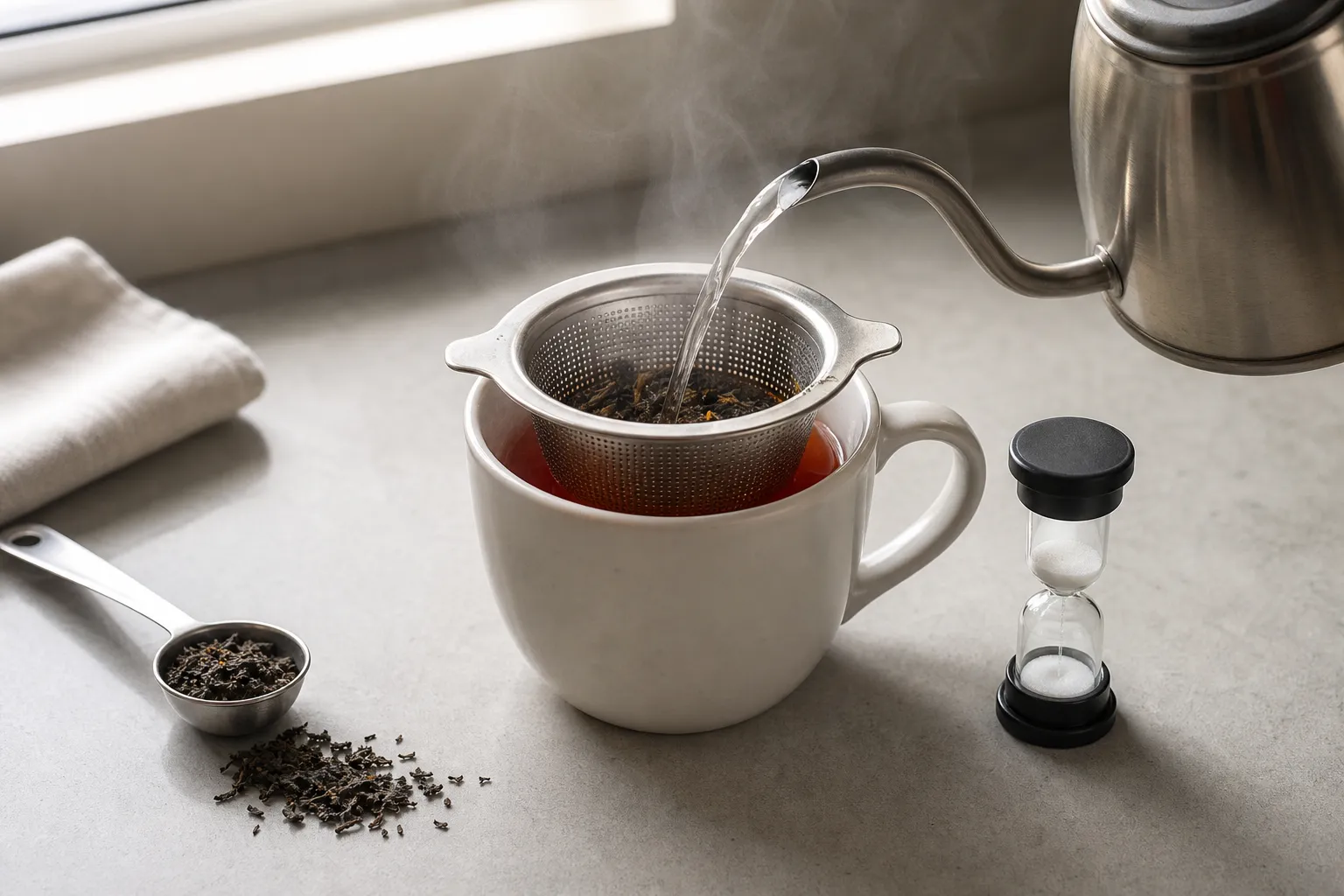
To brew loose leaf black tea in a mug, set a roomy basket infuser in the mug, add 2–3 grams of tea for an 8–10 ounce / 240–300 ml mug, pour in near-boiling water, steep for 3–5 minutes, then lift the basket out completely. Treat that as a starting recipe, not a rule for every black tea.
Small broken leaves and granular breakfast teas usually build strength quickly. Larger twisted leaves need more space in the basket and may sit better at the longer end of the steep. A good mug should smell clear, show amber to red-brown liquor, and feel full without becoming harshly drying. If the cup turns thin, bitter, flat, cloudy, or too strong, change one variable in the next mug.
upward
Read the full overview first
Use the broader guide first if you need the full scope before this page.
A practical one-mug method
This is the simple mug method: one mug, one basket, one timed infusion. It is not a double-pot concentrate, and it is not a small-vessel repeated-infusion session. The goal is a balanced cup you can drink plain, with milk, or with your usual additions.
-
Choose a basket that fits the mug.
A good basket infuser should sit securely on the rim, reach low enough into the water, and leave the leaves surrounded by liquid. If the basket is shallow and the top layer of tea stays above the water line, extraction will be uneven.
-
Add the tea.
Start with 2–3 grams for a standard mug. Without a scale, try about 1 level teaspoon of small broken leaf or 1 rounded teaspoon to 2 teaspoons of large, wiry leaf. Spoon measurements are rough because loose black tea can be dense, fluffy, twisted, or broken.
-
Pour in hot water.
For black tea in a mug, a useful starting temperature is water just off the boil, roughly 95–100°C / 203–212°F. A mug loses heat quickly, especially if it is cold, wide, or thin-walled. Pour so the water moves through the leaves, not only around the edge of the basket.
-
Steep with a timer.
Begin around 3 minutes for small broken leaves or strong breakfast blends, and 4–5 minutes for larger whole or twisted leaves. If the package gives a more specific range for that tea, use it as the closer starting point.
-
Remove the basket.
Lift the basket out when the timer ends and let it drain briefly. Do not leave it sitting in the mug while you drink unless you deliberately want the tea to keep getting stronger. Taste once before deciding whether the next mug needs more leaf, less time, milk, sugar, lemon, or no change at all.
The basket is not just a strainer
A common mistake is treating the infuser as something that only catches leaves at the end. In mug brewing, the basket is also the brewing chamber. The leaves need enough room to hydrate, loosen, and release flavor into the surrounding water.
A cramped tea ball or narrow insert can work for very small amounts, but it gives the leaves less room. With larger loose leaf black tea, a tight container can press the leaf into a dense clump. That can give you a strange cup: dark around the basket, but hollow or rough in the mug.
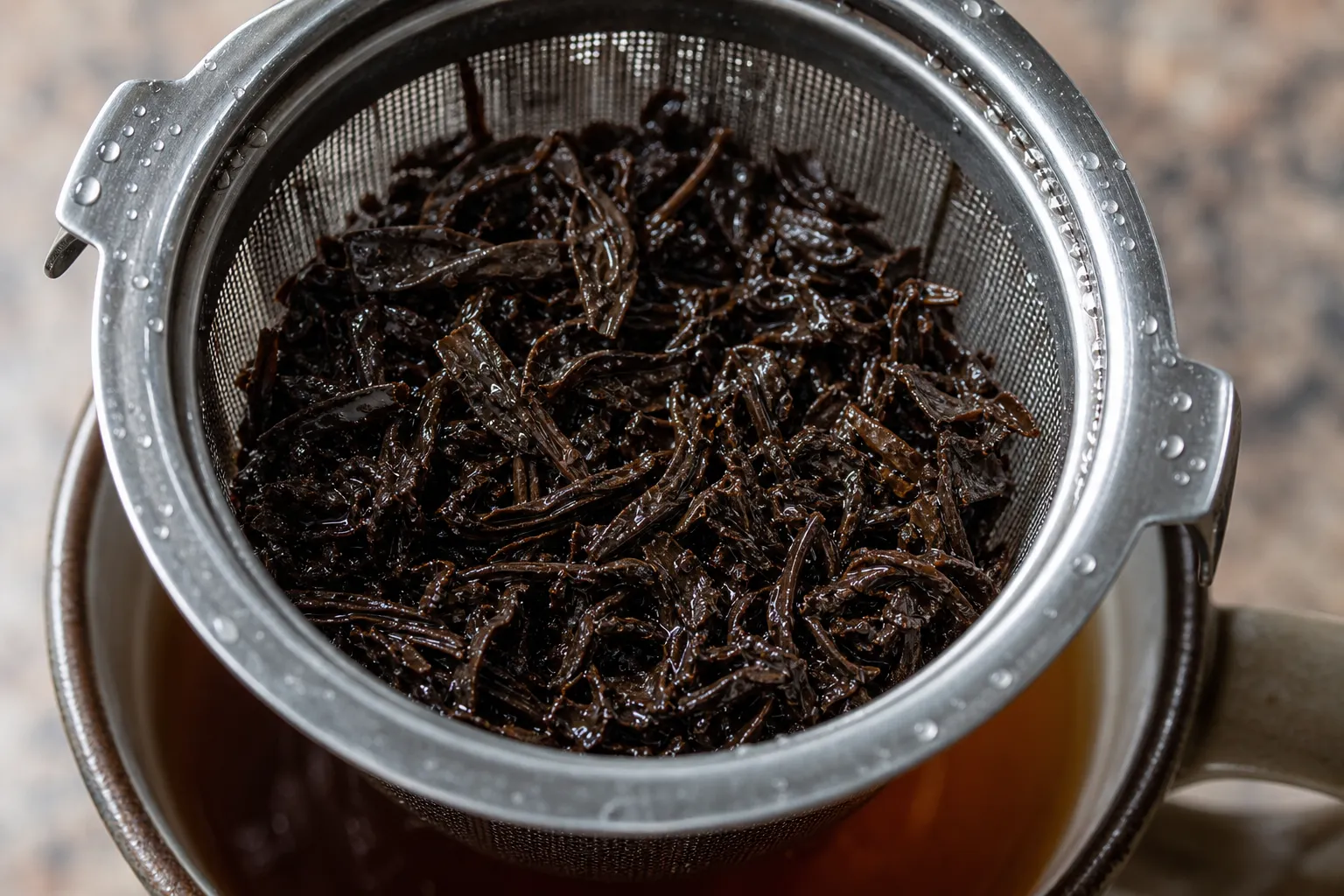
After steeping, look at the wet leaves. They should be fully soaked and loosened, not packed into a dry-centered plug. If the basket drains slowly because fine particles have formed a compact bed, use a little less tea next time, rinse the basket well, or choose a wider fine-mesh insert.
If your mug came with a built-in basket, check the same basics: does the basket sit deep enough, do the leaves stay under water, and is there open space above the dry leaf before brewing? A good-looking infuser mug still needs enough water contact to make a good cup.
Read the cup before changing the recipe
Color helps, but it is not the whole answer. Black tea may brew amber, copper, orange-red, or red-brown depending on origin, leaf form, blend, freshness, water, and strength. A pale cup may be under-extracted, but a delicate whole-leaf tea can still be lighter than a broken-leaf breakfast blend. A very dark cup may be strong, but darkness does not always mean better body.
Use these cues together:
-
Color: Is the liquor pale and watery, bright amber, deep copper, or nearly opaque? Cloudiness can come from fine particles, a strong brew, cooling, or the water itself.
-
Aroma: Does the steam carry the tea’s character clearly: malty, fruity, floral, caramel-like, brisk, smoky, or spicy? If the aroma is faint, the brew may be too weak, too cool, or made from tired leaf.
-
Body: Does the tea feel thin and quick, or does it have weight across the tongue? Body is not the same as bitterness.
-
Astringency and bitterness: A little brisk dryness can make black tea feel lively. Harsh astringency feels puckering and drying. Bitterness reads sharper on the tongue. They often show up together in an over-steeped mug, but they are not the same sensation.
Water can affect flavor and appearance, though it should not be blamed for every disappointing cup. If the same tea tastes flat after you have already checked leaf room, timing, and water temperature, trying a different drinking water is a reasonable experiment.
How to adjust the next mug
Change one thing at a time. If you alter leaf amount, steeping time, water temperature, and basket size all at once, you will not know which change helped.
| What you notice | What may be happening | Next adjustment |
|---|---|---|
| The tea tastes thin | Too little leaf, too short a steep, crowded leaves, or water cooling too fast | Add a little more tea, steep 30–60 seconds longer, or use a roomier basket |
| The tea tastes bitter | Too long a steep, too much small broken leaf, or a sharply extracting style | Shorten the steep by 30–60 seconds or use slightly less leaf |
| Harsh, dry, or puckering cup | Over-extraction, many fine particles, or a packed basket | Remove the basket sooner, avoid pressing the leaves hard, and make sure water can move through the basket |
| Flat aroma | Water not hot enough, stale or poorly stored tea, or a mug that cooled quickly | Use hotter water, cover the mug while steeping, or compare with fresher tea |
| Cloudy liquor | Fine leaf dust, long steeping, cooling, or water composition | If it tastes good, leave it alone. If it tastes muddy, use a finer basket, less leaf, or a shorter steep |
| Too strong for drinking plain | The ratio is high or the steep ran long | Dilute with hot water now; next time use less tea or stop earlier |
| Too weak for milk | The cup lacks enough body to carry milk | Use more leaf next time rather than leaving the same basket in for a very long steep |
For a stronger mug, adding a little more leaf is often cleaner than pushing the steep much longer. Extra time deepens color, but it can also bring more bitterness, drying astringency, and muddiness. For a softer mug, shorten the steep before dropping the temperature dramatically; most black teas are built for hotter water than many green teas.
Where this method stops
There is no single recipe that fixes the exact amount of black tea, basket size, water temperature, and steeping time for every mug. Leaf form, blend style, freshness, water, mug volume, and personal preference all change the answer. Use 2–3 grams, near-boiling water, and 3–5 minutes as a dependable starting point, then let the cup tell you what to adjust.
This page also does not decide whether every black tea should be steeped again. Some larger whole-leaf black teas may give a lighter second mug; many small broken or granular teas spend most of their strength in the first infusion. If you try a second steep, expect a paler cup and judge it by aroma and body rather than by the first mug’s color.
Before you drink, check the simple things: the basket was roomy, the leaves were fully wet, the water was hot, the steep was timed, and the basket came out. Most mug problems begin in one of those places.
Sources
Sources and further reading
Reference links are limited to sources considered suitable for public citation in this page.