
Buyer math
How to Compare Black Tea Price by Gram, Cup, and Serving
A black tea label can look like a bargain until you divide it by the amount of leaf you actually use. Start with the black tea price per gram: total price divided by net weight in grams. Then estimate your black tea cost per cup by multiplying that number by the grams you use for one brew.
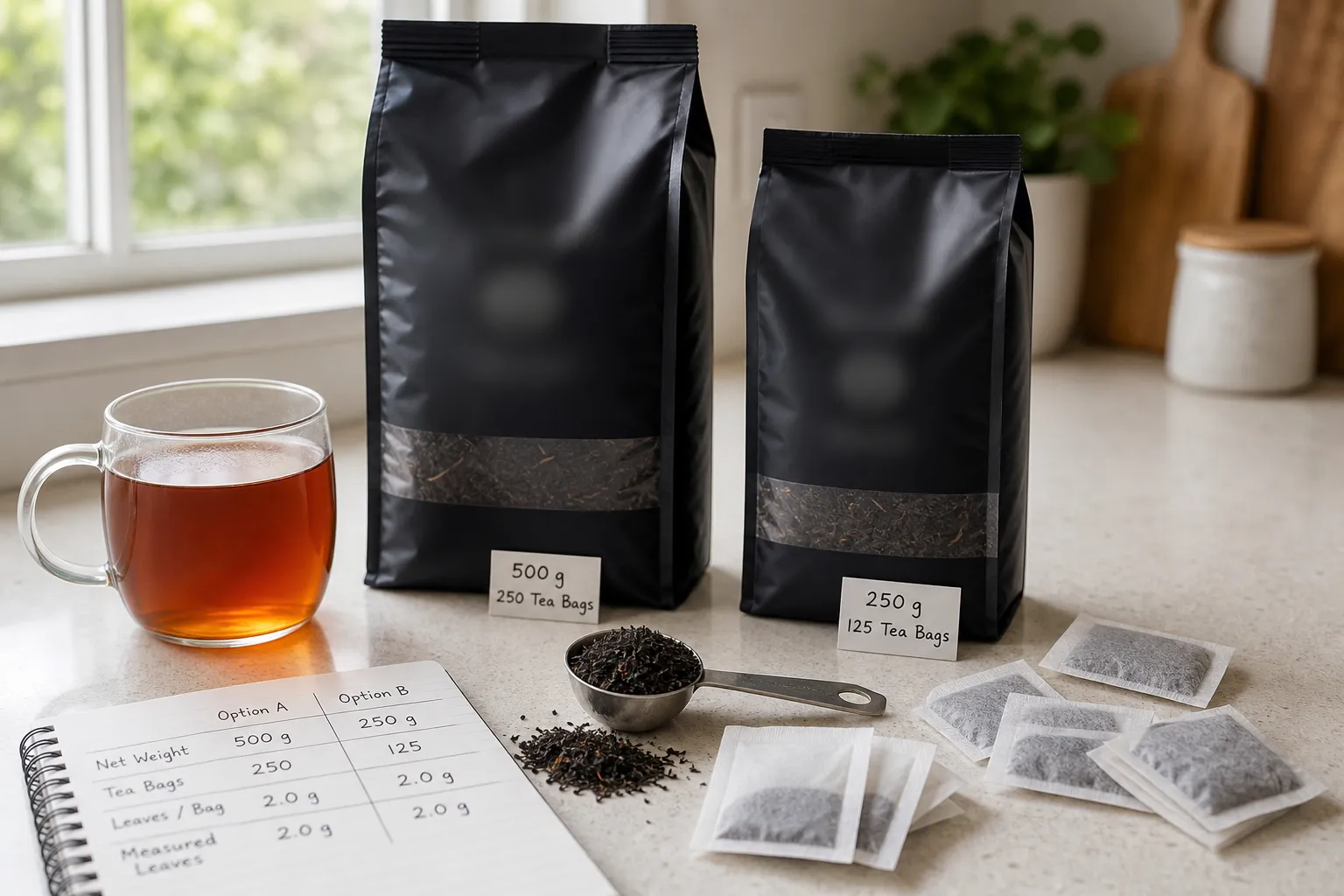
For tea bags, divide the total price by the tea bag count, then check whether the box also lists net weight. Price per bag and price per gram are both useful, but they are not the same comparison.
Keep the math separate from judgment. Price can tell you what one package costs under your brewing assumptions; it cannot prove flavor, freshness, origin quality, or value by itself.
upward
Read the full overview first
Use the broader guide first if you need the full scope before this page.
The Basic Math: Gram, Cup, and Serving
Use three layers because each one answers a different buying question.
| Comparison | Formula | What It Tells You |
|---|---|---|
| Price per gram | Total price ÷ net weight in grams | The cleanest weight-based comparison |
| Cost per cup | Price per gram × grams used per cup | What your usual brew costs |
| Price per serving | Total price ÷ stated or estimated servings | What the package implies, if serving size is clear |
For loose black tea, net weight is usually the simplest starting point. If a hypothetical 100 g tin costs $12, the price per gram is $0.12. If you use 2 g for one cup, that cup costs $0.24 before milk, sugar, lemon, shipping, or tax.
For bagged black tea, bag count helps but does not tell the whole story. A hypothetical $10 box with 50 bags costs $0.20 per bag. If the same box lists a net weight of 100 g, it also costs $0.10 per gram. Both numbers are true; they answer different questions.
“Serving” needs extra care. A package may treat one tea bag as one serving, or it may suggest a certain amount of loose leaf per cup. Your mug size, strength preference, and brewing ratio can move the real cost up or down.
Read the Package Before Comparing Prices
The useful numbers are usually visible: total price, net weight, tea bag count, and any stated serving size. If one package shows only bag count and another shows loose-leaf weight, compare them carefully instead of pretending the units match.
Start with net weight. It may appear in grams, ounces, or both. Use grams for every package so the calculation stays consistent. If the label gives ounces only, convert first, then divide.
Next, use the price you are actually paying. Shelf price, sale price, subscription discount, shipping, and tax can all change the final number. If you are comparing two teas in the same cart, use the visible item cost as consistently as possible. The goal is a fair comparison, not false precision.
Then read the brewing directions. A loose tea pouch may suggest an amount per cup; a bagged tea box may assume one bag per cup. Treat those directions as starting points, not universal serving rules. A brisk breakfast blend brewed strong for milk may need more leaf than a lighter cup brewed plain. A large mug may need more than a small teacup.
Finally, look at leaf form. Whole leaf, broken leaf, fannings, and dust can behave differently in an infuser or bag, but price alone does not tell you how the liquor will taste. Use leaf appearance as an observation, not a verdict.
Choose One Brewing Assumption
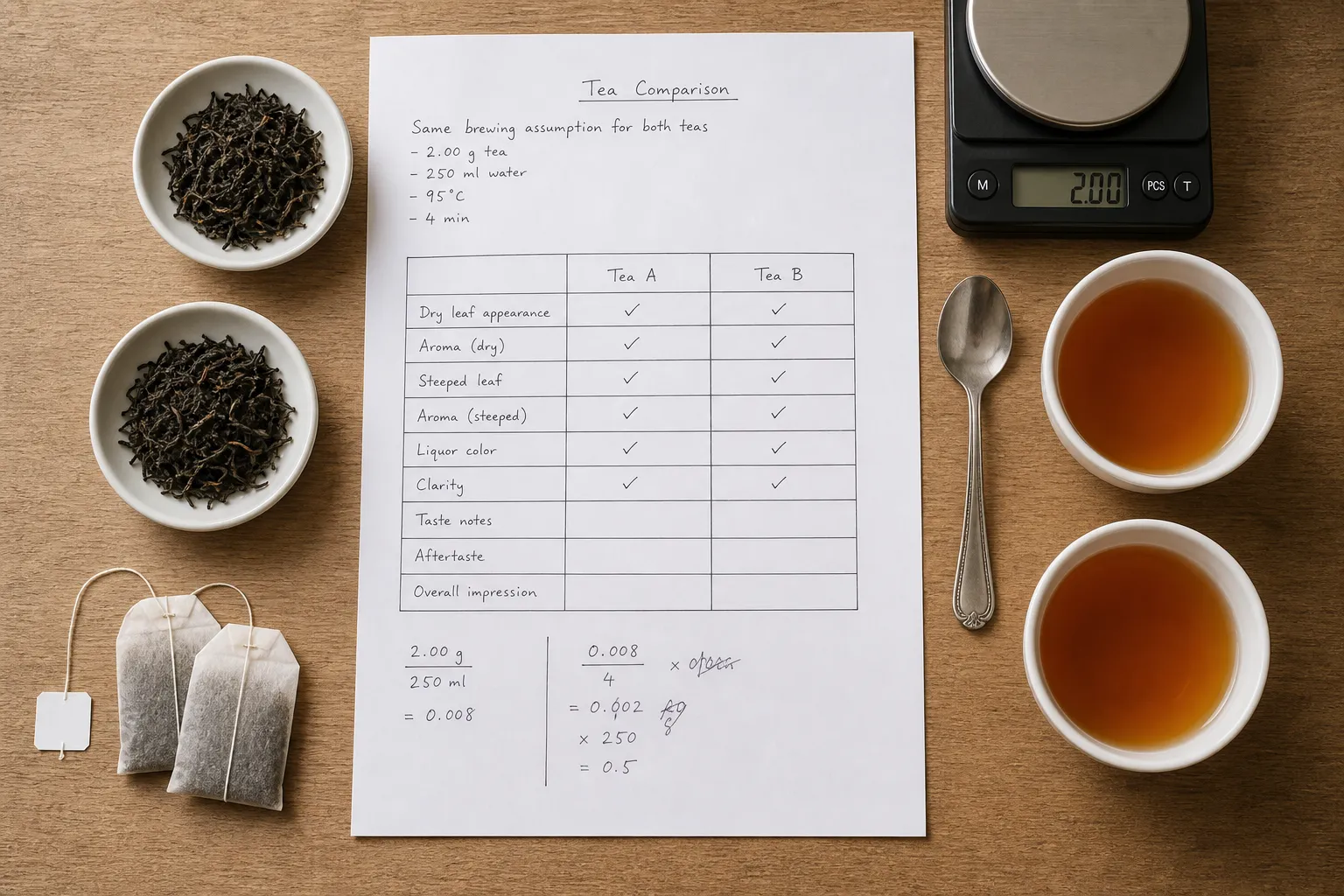
Cost per cup depends on brewing ratio: how much tea you use for a given amount of water. Without a consistent ratio, two prices are easy to misread.
Hypothetical Tea A
- $12 for 100 g = $0.12 per gram.
- Your brew: 2 g per cup.
- Estimated cup cost: $0.12 × 2 = $0.24 per cup.
Hypothetical Tea B
- $18 for 150 g = $0.12 per gram.
- Your brew: 2 g per cup.
- Estimated cup cost: $0.24 per cup.
Tea B has the higher sticker price, but in this example the loose black tea price is the same by gram. If you only looked at the package total, Tea B would seem more expensive than it is.
Cup strength is the next adjustment. If you use 3 g instead of 2 g because the tea tastes thin at your usual steep time, the cup cost rises. At $0.12 per gram, 3 g becomes $0.36 per cup. That does not make the tea poor value; it means your preferred cup uses more leaf.
For tea bags, use the same habit. One bag per cup makes price per bag close to price per cup. Two bags in a large mug doubles the cup cost. If one bag gives you the strength you want in a smaller cup, keep that assumption. The honest comparison is based on your real brewing pattern.
Re-steeping should be handled carefully. If you personally take a second infusion from a tea and enjoy it, you can divide the package cost across the cups you actually drink. Do not use that assumption to make a broad value claim unless you are comparing your own repeated brews under the same conditions.
When Price per Serving Helps
Price per serving is useful when the package clearly defines the serving. It becomes weaker when the serving is vague or when your cup does not match the label’s assumption.
For a tea bag box, serving can be straightforward if one bag equals one serving. A hypothetical $8 box with 40 bags costs $0.20 per bag. If you brew one bag per cup, price per serving and price per cup are the same for your use. If you brew two bags for a stronger mug, your cup costs $0.40.
For loose tea, serving size depends on the package directions or your own measurement. Suppose a hypothetical 80 g pouch costs $16. The price per gram is $0.20. If the package suggests 2 g per serving, the implied price per serving is $0.40. If you prefer 3 g for a fuller cup, your personal serving cost is $0.60.
Label the difference clearly: package serving versus your serving. That small distinction prevents many muddy comparisons.
A larger package may lower the per-gram number, but that does not automatically make it the better purchase. If you drink that tea slowly and the leaf loses aroma in poor storage, the lower math may not match your cup experience. If you buy a small amount of a style you are still learning, a higher per-gram price may be acceptable because it limits waste.
Serving math also should not stand in for quality. A higher price may reflect packaging, origin claims, smaller batch handling, retailer margin, or other factors not checked by this page. A lower price may reflect larger package size, simpler presentation, or sale pricing. For this narrow comparison, price is a cost signal, not a complete value judgment.
A Small Worksheet for Comparing Two Teas
Use this when you want to compare black tea prices without getting pulled into marketing language.
| Line Item | Tea 1 | Tea 2 |
|---|---|---|
| Total price | ||
| Net weight in grams | ||
| Tea bag count, if any | ||
| Price per gram | ||
| Package serving size | ||
| Your grams per cup or bags per cup | ||
| Your estimated cost per cup | ||
| Re-steeping included? | Yes / No | Yes / No |
| Notes on cup strength | ||
| Storage risk if buying larger size |
The notes line matters. Two teas can have the same cost per cup and still serve different roles. One may taste better with milk; another may show a clearer aroma when brewed plain. One may be a daily breakfast cup; another may be a small-quantity purchase for tasting a new origin or style.
If you are comparing loose tea with bagged tea, do not force them into one number too quickly. Calculate price per gram if both packages show net weight. Calculate cost per cup using your normal brew. Then write down the practical difference: loose leaf may require an infuser and measuring habit, while bags may be easier for travel or office brewing. Convenience is part of value, but it is not the same as price per gram.
What Price Cannot Tell You
This page does not have usable public references for market averages, typical black tea prices, average serving sizes, retailer pricing patterns, or broad loose-leaf-versus-bagged value claims. The formulas are reliable as arithmetic, but they do not say what every black tea should cost.
Price also cannot prove freshness. A costly tin may have been stored poorly after opening. A modest package may taste lively if it is fresh, sealed well, and brewed at a ratio you enjoy. After purchase, use observable clues: aroma when opened, dryness of the leaf, tightness of the container, and protection from light, heat, moisture, and strong odors.
Price cannot prove taste preference either. Some readers like a brisk, astringent cup that stands up to milk; others prefer a softer, malty or fruity black tea brewed plain. A tea that costs less per cup but needs more milk or sugar to suit your taste may not feel like the better buy. A tea that costs more but satisfies you with less leaf may compare differently in practice.
Price also cannot confirm origin, grade, or production claims on its own. If those details matter, look for clear package wording and retailer information, then treat unsupported claims cautiously. For cost comparison, stay with what you can see and calculate: net weight, total price, serving direction, bag count, and your own brewing ratio.
A Compact Final Choice
Use price per gram to compare package cost. Use cost per cup to compare your real brewing habit. Use price per serving only when the serving size is visible or when you clearly define your own.
“Tea A costs less per gram, but I use more leaf for the strength I like. Tea B costs more per gram, but I enjoy it at a lighter ratio. They are close per cup, so I’ll choose based on flavor and how quickly I can finish the package.”
That is the cleanest comparison: let the label give you the numbers, let your brewing ratio show the cup cost, and let the brewed black tea decide whether the price is worth repeating.