Buying comparison
How to Compare Two Black Teas Online Before Buying
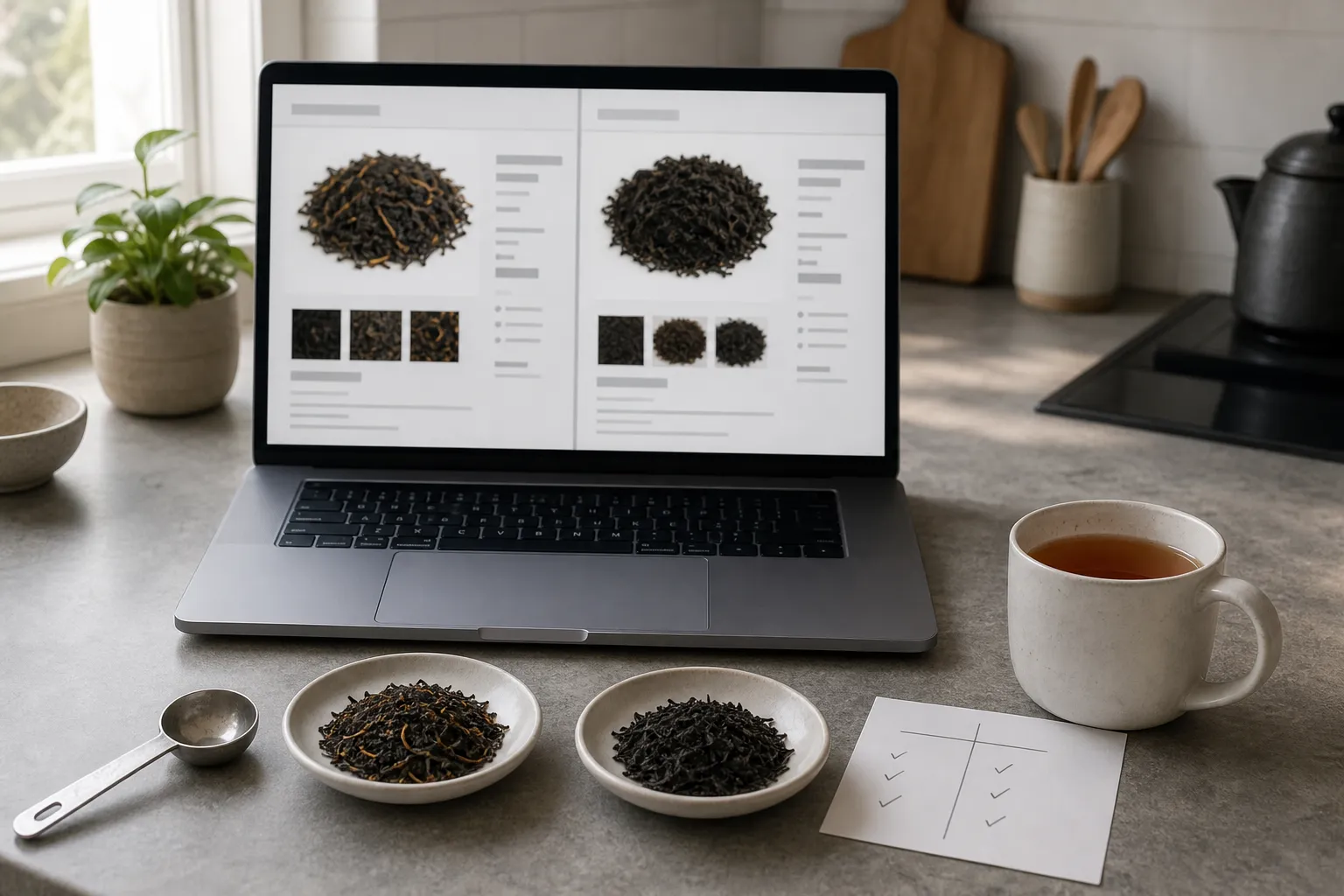
A dry-leaf photo can help, but it cannot taste the tea for you. To compare black tea online before buying, place the two listings side by side and check the same practical clues: leaf form, grade wording, origin or style name, brewing instructions, flavor notes, freshness detail, packaging, sample size, and how openly the seller explains the tea.
The useful question is not which listing sounds more impressive. It is which tea gives you clearer evidence for the cup you want, and which gaps are large enough that a sample or smaller bag makes more sense.
upward
Start with the broader guide
Use the broader guide first if you need the full scope before this page.
Start With the Cup You Want
Before reading the labels too closely, name the cup you are trying to make.
If you want a brisk morning tea with milk, a broken-leaf Assam, CTC-style tea, fannings, or a short-steep breakfast blend may fit better than a delicate whole-leaf tea described as floral and light. If you want a slower plain cup, a whole leaf black tea with clear brewing guidance and notes such as malt, dried fruit, honey, cocoa, spice, or gentle smoke may be easier to judge.
Read each black tea product description as a set of clues, not as proof. Words such as “smooth,” “strong,” “aromatic,” “premium,” and “high quality” are common retail language. They become more useful when they sit beside leaf photos, origin detail, harvest or packing information, and steeping instructions. Alone, they are too loose to settle the comparison.
Quick side-by-side check
Leaf form shown or described
Suggests extraction speed and cup texture.
Origin, region, or style named
Adds context, but not a fixed flavor promise.
Grade term explained
Keeps acronyms from being mistaken for simple quality scores.
Brewing instructions included
Shows how the seller expects the tea to behave.
Flavor notes specific
Helps match the tea to your preference.
Freshness or packing detail
Gives storage and handling clues.
Sample or small size available
Lowers the cost of being wrong.
If one listing gives a close dry-leaf photo, weight, brewing ratio, steep time, packing detail, and grounded flavor notes, it is easier to compare than a listing built mostly from praise. Clearer does not always mean better. It means less guessing.
Read Leaf Form Before Grade Language
Black tea grade terms can help, but they are often overread. Many describe leaf size, wholeness, tip content, or processed form. They do not create one universal ranking for flavor.
Orange Pekoe is a common example. In black tea, Orange Pekoe is a grading term, not orange-flavored tea. A tea labeled OP is not automatically citrusy, and a tea without OP is not automatically worse. It is a clue about leaf presentation within certain grading traditions.
Common grade and leaf-form clues
- OP often points to a larger leaf presentation within an Orange Pekoe-style grading system.
- BOP usually means broken Orange Pekoe, a smaller broken-leaf form.
- FOP and TGFOP point toward leaf with tips where those terms are used.
- Fannings and dust are much smaller particles, often used for tea bags or fast extraction.
The key word is “often.” Grading systems vary by region and tea tradition. A Chinese black tea listing, an Indian estate tea, and a British-style breakfast blend may use naming and grading language differently. Do not force every label into one ladder.
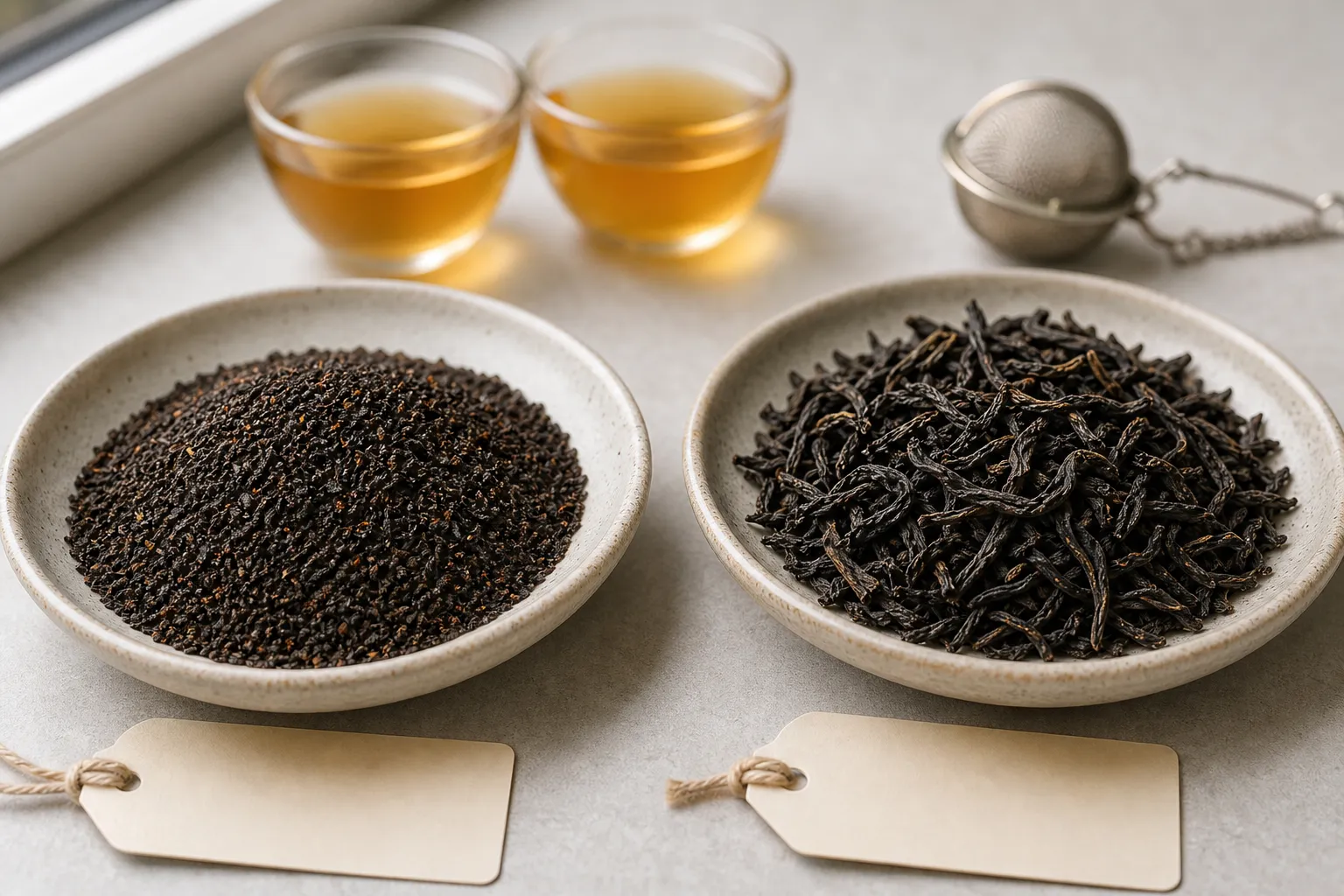
Leaf form affects how the tea may brew. Smaller particles usually release color and strength quickly, which can work well for a short steep, a strong cup, or milk tea. Larger whole leaves may extract more slowly and give more room for aroma changes during a careful steep. That does not make whole leaf automatically better; it makes it different.
When two listings use grade terms, look for what the seller actually shows. Are the leaves wiry, twisted, broken, fine, tippy, or pellet-like? Does the brewing advice match the leaf size? A listing that says “whole leaf” but shows only a dark scoop from far away gives you less to work with than a plainer listing with a clear close-up.
For buying, treat grade terms as shape and brewing-behavior clues. Let your cup preference decide the rest.
Match Origin With Brewing Advice
Two black teas can share a broad name and still brew very differently. Research on black tea taste formation supports a modest point useful to shoppers: cultivar and processing variables, including withering, can affect sensory qualities. The name on the listing is only part of the tea.
That matters with origin labels. “Assam,” “Ceylon,” “Yunnan,” “Keemun,” “Darjeeling black tea,” “English Breakfast,” and “Congou” can help you place a tea culturally or stylistically, but each label still leaves room for variation. Estate, harvest, cultivar, processing, blending, storage, and brewing ratio can all change the cup.
Compare origin labels with brewing instructions, not separately.
A useful listing gives some direction: water temperature, amount of leaf, steep time, and whether the tea is meant for plain drinking or milk. You do not need laboratory precision to shop well. You do need enough information to imagine the first brew.
Look for brewing directions that make the listing testable
- Leaf amount per cup or per volume of water.
- Suggested water temperature, or a simple near-boiling cue.
- Steep time, especially for broken leaf, fannings, or dust.
- Resteeping guidance for larger-leaf styles.
- Notes about milk, lemon, sugar, or plain drinking.
If Listing A suggests 2–3 minutes and shows finely broken leaf, while Listing B suggests 4–5 minutes and shows larger twisted leaves, the difference is not just tone. The two teas may be built for different extraction speeds and drinking habits.
Be cautious with listings that promise a flavor experience but give no method. A black tea described as “smooth and rich” can become thin, harsh, flat, or pleasantly full depending on leaf quantity, water, time, and freshness. Brewing instructions do not prove quality, but they make the seller’s expectation easier to test.
Weigh Flavor Words Like Clues
Black tea flavor descriptors are most useful when they are specific and consistent with the rest of the listing. “Malty,” “brisk,” “smoky,” “fruity,” “floral,” “nutty,” “earthy,” “cocoa,” “spiced,” and “sweet aroma” help you imagine direction. They do not mean your water, kettle, cup size, steeping habit, and palate will read the tea the same way.
Give more weight to sensory words that suggest structure. “Brisk” usually points toward lively astringency. “Full-bodied” suggests weight in the mouth. “Light” may suggest less density, though steeping can change that. “Smoky” is more useful than “bold.” “Raisin-like” or “cocoa” tells you more than “delicious.”
Also notice when the language is too broad. “Superior aroma,” “finest taste,” and “excellent quality” do not tell you whether the cup is malty, bright, woody, fruity, tannic, soft, or smoky. Those phrases may be normal retail language, but they should not win the comparison by themselves.
Listing A
“Broken leaf Assam, strong, brisk, takes milk, 3-minute steep.”
This may suit a fast breakfast cup.
Listing B
“Whole leaf Yunnan black tea, cocoa and dried fruit notes, 4-minute steep, plain drinking suggested.”
This may suit slower tasting without milk.
Neither is automatically the better tea. The better choice depends on the cup you want.
If both listings use appealing flavor words, choose the one that connects those words to visible or practical details: leaf form, origin, harvest, brewing method, or sample availability.
Check Freshness, Packaging, and Openness
Freshness is hard to prove from a product page, but you can compare how much the seller lets you inspect.
Useful black tea packaging details include a packed date, harvest season when relevant, batch or lot note, bag size, resealable packaging, opaque pouch or tin, and a clear storage description. Tea is best protected from light, air, moisture, heat, and strong odors. That is a storage clue, not a promise that one tea will taste better than another.
When you compare tea freshness dates, do not treat the newest date as the only answer. Some black teas are blended for consistency; others are sold by harvest or batch. A listing that explains what the date means is more helpful than one that simply says “fresh.”
Seller transparency matters because online buying leaves gaps. You cannot smell the dry leaf, inspect the exact batch in your hand, or taste the liquor before checkout. A more useful listing may include:
- Multiple photos, including a close dry-leaf image.
- Clear weight and serving estimate.
- Brewing instructions that match the leaf form.
- Origin, blend, or style information without exaggerated claims.
- Sample-size availability or a small trial bag.
- A way to ask about harvest, packing, or preparation.
Reviews can help you notice buyer language, but they are not a substitute for the listing. One drinker’s “too strong” may be another drinker’s ideal breakfast cup. One person’s “smooth” may come from a shorter steep or softer water. Use reviews to spot repeated comments about body, aroma, bitterness, packaging, and freshness, then return to the product details.
If a seller offers samples, that is often the cleanest tie-breaker. A small purchase lets you compare the actual cup instead of leaning too heavily on adjectives.
What Online Listings Cannot Tell You
Online comparison narrows the choice; it does not finish it. Formal black tea evaluation can involve defined requirements, sensory assessment, moisture measures, and laboratory methods that ordinary retail pages do not show. That does not make shopping impossible. It means a product page is a buying aid, not a full evaluation.
Even a strong listing cannot tell you exactly how the tea will taste with your water, kettle, mug, steep time, milk, or preferred strength. It cannot fully show aroma after opening, how quickly the cup becomes astringent, or whether the finish feels clean or rough to you. It also cannot settle personal preference.
This is where many online comparisons drift. A shopper sees a longer grade acronym, a famous origin, or a polished description and treats it as the answer. Those details can help, but they do not replace brewing and tasting.
Final filter before buying
- If both teas are unfamiliar, choose the one with a sample or smaller size.
- If one tea has clearer leaf photos and brewing guidance, give it more trust.
- If a grade term is the main selling point, check whether the listing explains the leaf form.
- If flavor words are vague, look for a more specific description or ask the seller.
- If you want milk tea, do not dismiss broken leaf, fannings, or dust automatically.
- If you want slow plain tasting, look closely at whole-leaf photos, origin notes, and steeping advice.
The better online choice is the tea whose visible details match your intended cup with the fewest unresolved questions. Buy that one in the smallest sensible amount, brew it according to the seller’s guidance first, then adjust leaf, water, and time before judging the tea.
Sources
Sources and further reading
Reference links are limited to sources considered suitable for public citation in this page.