Western brewing
When to Remove Black Tea Leaves in Western Brewing
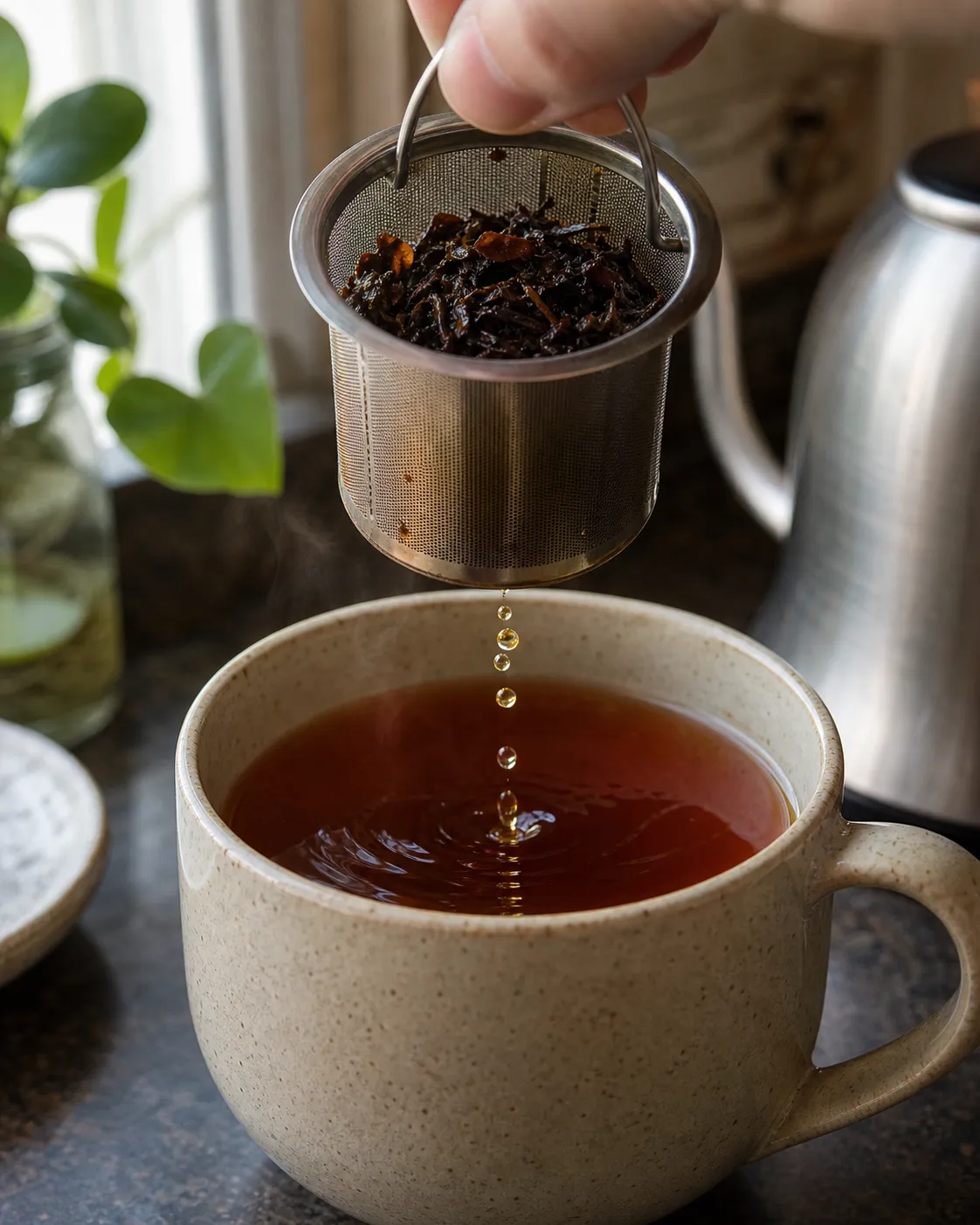
Remove black tea leaves when the tea has reached the strength, aroma, and mouthfeel you want. In Western brewing, that usually means ending the infusion by lifting the infuser, removing the tea bag, straining loose leaves, or decanting the brewed tea into a second vessel.
The practical answer to when to remove black tea leaves is simple: stop leaf-to-water contact as soon as the cup tastes balanced to you. If the leaves stay in hot water, the tea keeps infusing and may become stronger, more bitter, or more drying, depending on the leaf, water, ratio, and time.
upward
Read the full overview first
Use the broader guide first if you need the full scope before this page.
The simple rule: separate the leaves from the liquor
Western black tea brewing is usually a timed infusion. You put tea leaves or a tea bag in hot water, wait long enough for the cup to develop flavor and body, then separate the brewed tea from the leaf.
That can mean:
- Lifting the infuser basket from a mug or teapot.
- Removing the tea bag and letting it drain briefly.
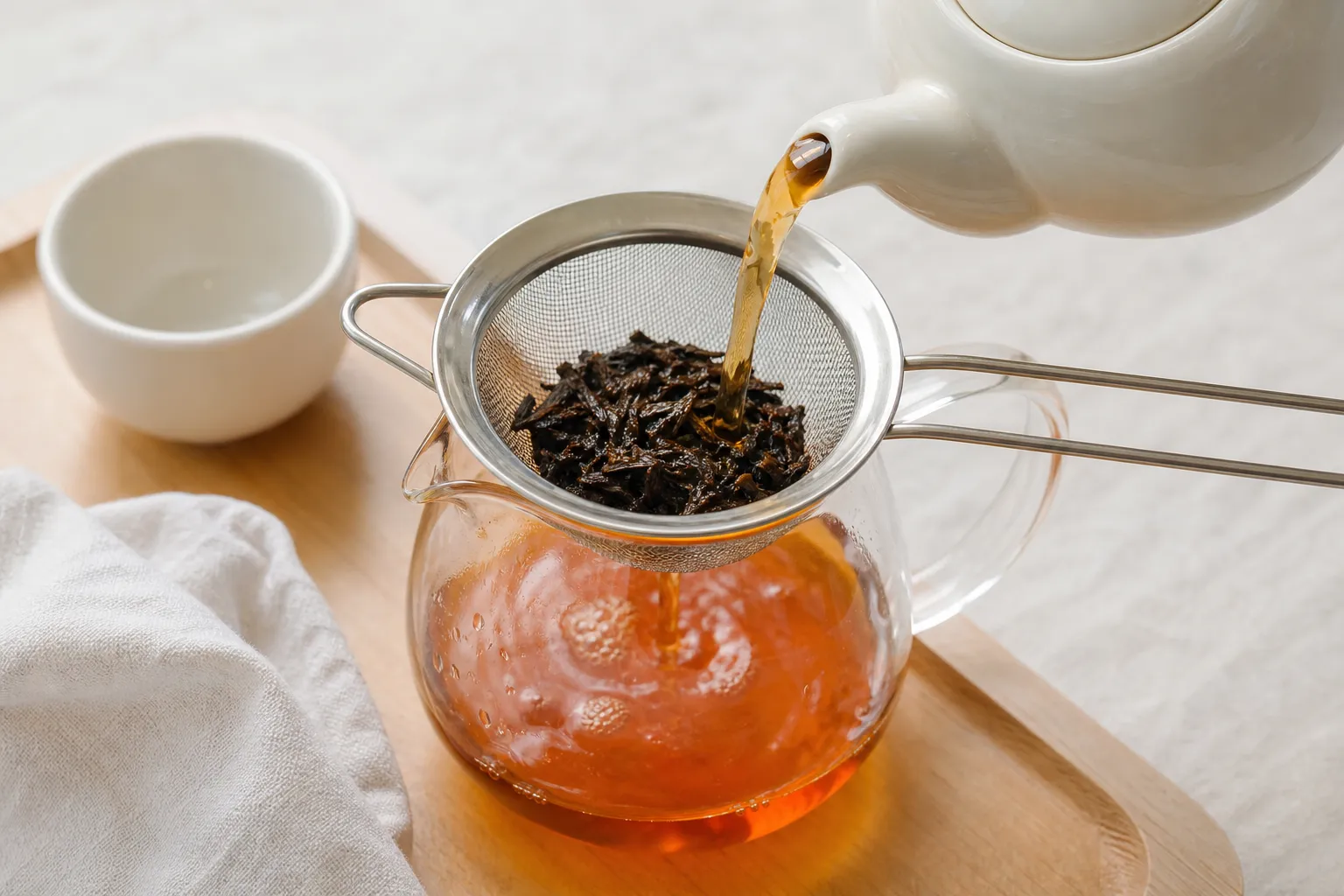
- Pouring through a strainer if loose leaves are floating freely.
- Decanting the tea from a brewing pot into a second warmed pot or serving vessel.
These are different tools for the same job: stopping the tea from steeping.
A useful distinction is this: tea with leaves still in the water is still infusing; brewed tea without leaves is just sitting. A pot of black tea that has been strained into another pot may cool or lose some aroma over time, but it is no longer extracting from the leaf in the same way.
Formal sensory standards such as ISO 3103 also use timed infusion and separation of liquid from leaves, but that is a controlled tasting method, not a universal home recipe. At home, the goal is not laboratory comparison. The goal is a cup you want to drink.
How to tell the cup is ready
A timer helps, but the cup itself gives better clues. Black tea does not jump from “not ready” to “ruined” in one second. It changes gradually while the leaf remains in contact with hot water.
Pale liquor, faint aroma, thin body
The infusion may be too short or too light for your taste. Steep a little longer next time or use slightly more leaf.
Clear aroma, rounded body, lively briskness
The tea may be near your preferred balance. Remove the leaves or decant.
Sharp bitterness, rough edge, very drying finish
The tea may have gone past your preferred point. Remove sooner next time or reduce the leaf amount.
Dark color but weak flavor
Color alone is not a reliable guide. Taste before deciding the tea is ready.
Strong aroma but harsh mouthfeel
Flavor has developed, but extraction may be too intense. Shorten the infusion or adjust leaf amount next brew.
Color is useful with a familiar tea, but it is not enough by itself. Some black teas darken quickly before they taste full. Others look lighter while still having plenty of briskness and aroma.
Near the end of your usual black tea steeping time, take a small sip. If the tea has the body and briskness you want, remove the leaves. If it tastes hollow, give it a little more time. If it is turning rough, end the infusion and adjust the next brew.
What changes the right removal point
There is no single removal time that fits every black tea. U.S. and UK tea association guidance commonly treats tea as a timed brew, but those conventions are best read as household starting points, not one correct time for every leaf.
Several ordinary variables affect when to lift the tea infuser or strain the pot.
Leaf size and leaf form
Fine particles, fannings, and many tea bags release flavor quickly because more surface area is exposed to the water. CTC black teas and broken-leaf breakfast blends can become strong and brisk fast. If they sit too long, they may become harsher than you prefer.
Whole-leaf loose black tea often opens more slowly. It may need more time to develop body, especially in a larger teapot or with a lighter leaf-to-water ratio. That does not mean whole leaf should sit indefinitely; it only means its best removal point may come later than a fine-cut bagged tea.
Tea bag versus loose leaf
A tea bag is usually removed directly from the mug or pot. Loose leaf may be handled with an infuser, a strainer, or a second teapot.
The important difference is not only “teabag versus loose leaf.” It is whether you can separate the leaf from the water cleanly. A roomy infuser basket can be lifted. Free-floating loose leaf in a pot needs straining or decanting. If the leaves remain in the teapot after you pour one cup, the tea left behind may keep strengthening.
That is why Western black tea decanting matters most when you brew more than one serving. If you make a full pot and plan to drink it over several minutes, pouring the brewed tea into a second vessel can keep the later cups closer to the first cup’s strength.
Leaf amount and vessel size
More leaf in the same amount of water usually reaches a strong cup sooner. Less leaf may need more time, but longer time cannot always make a thin brew taste full. At some point, the cup may become more drying without gaining the body you wanted.
A small mug, a large pot, a narrow infuser, and a crowded tea ball can all change how the leaves meet the water. If the leaf cannot expand or circulate well, the cup may taste uneven: dark in color but flat in aroma, or strong around the edges without much depth.
Water temperature and freshness
Hotter water generally extracts faster than cooler water. Very fresh, aromatic black tea may show fragrance early. Older or poorly stored tea may need more leaf, or may simply taste flatter than it once did.
The removal point should follow what is actually in the cup: aroma, body, briskness, bitterness, and drying sensation.
How to adjust the next brew
Change one thing at a time. You do not need a formal tasting setup; a simple memory of what happened is enough.
If the tea was too harsh, bitter, or drying
- Remove the leaves sooner next time.
- Use a little less tea.
- Do not leave the tea bag or infuser in the mug while you drink.
- If brewing a pot, strain or decant all the tea once it is ready.
If the tea was too weak, thin, or faint
- Let it steep a little longer before removing the leaves.
- Use slightly more leaf rather than relying only on a much longer steep.
- Make sure loose leaf has enough room in the infuser.
- Check that the water was hot enough for the black tea you are brewing.
If the first cup from a pot tastes right but the second tastes too strong, the leaves probably stayed in contact with the remaining liquid. The fix is not necessarily a different tea. It may be a different stopping method: strain the whole pot, or decant the brewed tea into a second vessel.
If your mug tastes fine at first but becomes rough as you drink, check whether the leaves or tea bag are still sitting in the water. Removing them is the simplest way to stop black tea steeping.
Common misunderstanding: removing leaves does not weaken the tea
Some drinkers hesitate to remove black tea leaves because they think the cup will become weak. It will not. Removing the leaves preserves the strength the tea has already reached. It does not undo the infusion.
Once the brewed liquor is separated from the leaves, the tea still has the color, aroma, body, and briskness extracted during the steep. What changes is that the leaf is no longer adding more.
The timer can also be misunderstood. Timed brewing is useful because it gives you repeatability. If a certain breakfast blend tastes right after a particular steep, you can repeat it tomorrow. But the timer should serve the cup, not override it. A different black tea, a fresh packet, a finer leaf grade, or a larger mug can shift the right removal point.
There is also a preference habit here. In some Western household settings, especially with everyday tea bags, people leave the bag in longer for a stronger cup or remove it quickly for a lighter one. That is a personal brewing choice, not a rule for all black tea. If you enjoy a very strong, brisk cup, your removal point may be later than someone who dislikes a drying finish.
A narrow note on timing and sources
The best-supported guidance for this question is practical rather than absolute. Public tea association guides describe familiar Western brewing habits around timing and removing or separating tea. ISO 3103 shows that timed infusion and separation can be used in controlled sensory testing, but it is not meant to define the most pleasant household cup.
For home brewing, the useful boundary is sensory: while black tea leaves remain in hot water, extraction continues. Longer contact often makes the cup stronger and can make it more bitter or more astringent, depending on the tea and brewing conditions.
Quick answer for the kettle
Remove the leaves when the tea tastes ready, not when the leaves have sat for as long as possible.
For a mug, lift the infuser or remove the bag. For loose leaf in a pot, strain or decant the brewed tea so the remaining liquid is no longer sitting with the leaves.
If the cup is thin, extend the next infusion slightly or use more leaf. If it is bitter, rough, or very astringent, remove the leaves sooner next time. The right moment is the point where your black tea has enough aroma, body, and briskness without crossing into a mouthfeel you do not enjoy.
Sources
Sources and further reading
Reference links are limited to sources considered suitable for public citation in this page.