
Brewing ratio
How Much Loose Leaf Black Tea to Use per Cup
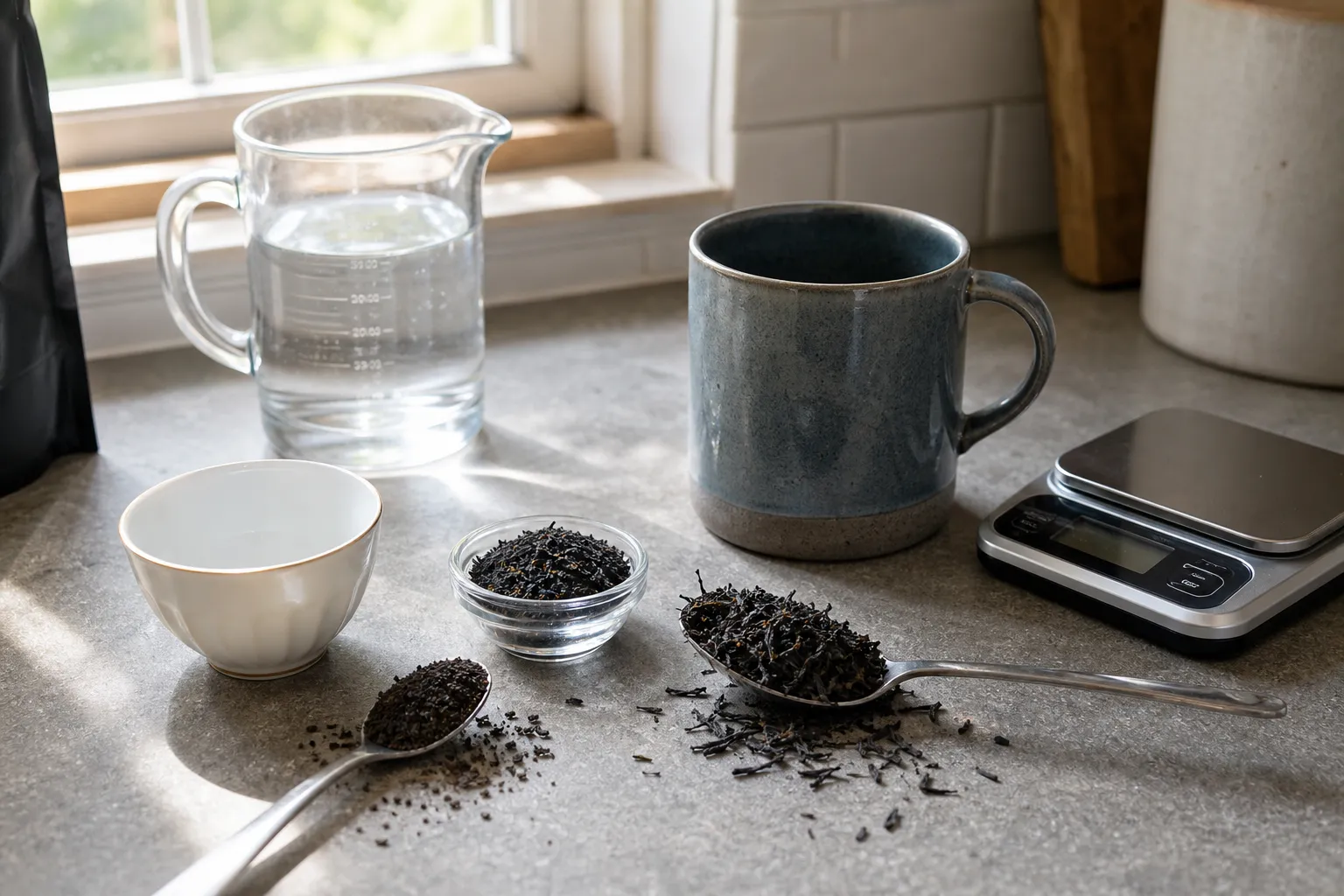
Start with about 2 grams of loose leaf black tea for 6 ounces of water, or about 3 grams for an 8-ounce mug. If you measure by spoon, that is usually around 1 level teaspoon for small broken leaves, or 1 heaping teaspoon to 1 tablespoon for larger whole leaves.
That is a practical black tea leaf to water ratio, not a fixed rule. Cup size, leaf shape, steeping time, water, freshness, and your preferred strength all change the final cup. A compact breakfast blend may taste full with a modest scoop; a wiry whole-leaf black tea may need a larger-looking spoonful before it has the same body.
upward
Start with the broader guide
Use the broader guide first if you need the full scope before this page.
A Simple Starting Ratio for Loose Leaf Black Tea
Choose the water volume first. Tea instructions often use a smaller “cup” than the mug people actually drink from, so the amount of water matters more than the word cup.
Water amount
Leaf amount
Spoon measure
6 oz / 180 ml
about 2 g
about 1 level teaspoon of small broken leaf
8 oz / 240 ml
about 3 g
about 1 heaping teaspoon, more for large leaves
12 oz / 350 ml
about 4–5 g
about 1½ to 2 teaspoons, depending on leaf size
16 oz / 475 ml
about 6 g
about 2 to 3 teaspoons, depending on leaf size
These numbers are best used as a repeatable brewing baseline. The supplied material for this page did not include public citation-grade sources for one universal black tea grams per cup standard, so the useful answer stays practical: measure once, taste the cup, then adjust.
If you brew by habit, weigh your usual spoonful once or twice. After that, you will know what 3 grams looks like in your own teaspoon, with your own tea.
Why Teaspoons Can Mislead
A teaspoon measures volume, not weight. Loose black tea is too varied for volume to be exact.
Small broken leaves and fine breakfast-style blends settle densely into a spoon. A level teaspoon may be enough for a moderate 6-ounce cup. Long, twisted leaves take up more space and trap more air, so the same teaspoon may weigh less and brew lighter. Large rolled or tippy leaves can look generous in the spoon while still making a softer cup.
If the package gives brewing directions, use them for the first cup. If it does not, the gram-based ratio is steadier than a spoonful chosen by sight.
Use the leaf form as a clue
- Fine or broken leaf: start a little lower; small particles extract quickly and can become brisk fast.
- Medium leaf: start near the basic ratio and adjust by taste.
- Large whole leaf: use more spoon volume, or weigh it, because a full spoon may still be a light dose.
- Blended black tea with added pieces: judge the brewed cup, not just the scoop, because fruit, spice, or flavoring pieces can change volume without adding the same tea strength.
Adjust by Strength, Body, Aroma, and Briskness
Once you have a baseline, change one variable at a time. Leaf amount, steeping time, and water temperature can all make the cup stronger, but they do not change the flavor in the same way.
If the cup tastes thin, increase the leaf slightly before making the steep much longer. More leaf often builds body, aroma, and color while keeping the extraction controlled. A longer steep can add strength too, but it may also bring more bitterness or drying astringency, especially with smaller-cut leaves.
If the cup smells good but tastes weak, add more leaf next time. The aroma is present, but the liquor does not have enough weight.
If the cup has body but feels too sharp, shorten the steep before reducing the leaf. That can keep the tea full while softening the edge. If it still feels harsh, use a little less leaf in the next brew.
A simple adjustment path
- Brew one cup at the starting ratio.
- Keep the water volume the same.
- Change only one variable in the next cup.
- Move in small steps, about 0.5 g more or less for an 8-ounce mug.
- Keep the version that tastes balanced.
Black tea sensory adjustments are easier when you compare the cup you actually brewed, not a memory of a different tea in a different mug.
When to Use More Leaf
Use more loose black tea per cup when the brew tastes pale, hollow, or too quiet for the way you plan to drink it. Milk, sugar, lemon, and food can make a delicate cup feel less present, so a slightly stronger dose may suit those settings.
For milk, start around 3 grams per 8 ounces, then move upward if the flavor disappears after adding milk. The goal is not an extreme dose; it is enough body for the cup you want.
Use more leaf for larger mugs, too. A 12-ounce mug is not one practical tea cup in brewing terms. If you use the same teaspoon that worked in a small teacup, the result will likely be lighter. Scale the leaf with the water first, then fine-tune.
Older tea may also need a little more leaf, though extra leaf cannot fully restore faded aroma. If the dry leaf smells flat and the cup tastes dull, more tea may build color and strength, but it may not bring back the top notes lost in storage.
Use more leaf when you want a fuller cup. Use a longer steep when you also want more extraction.
When to Use Less Leaf
Use less leaf when the cup becomes heavy, bitter, drying, or muddy. These black tea astringency cues are especially useful with small broken leaves, strong blends, or cramped infusers where the leaf has little room to open.
A cup can be too strong in more than one way. If it is concentrated but still clean, reduce the leaf a little. If it is sharp and drying, shorten the steep as well. If it is flat and rough at the same time, check freshness and storage before blaming the ratio alone.
A lighter cup may also suit people who are sensitive to caffeine or who prefer black tea later in the day. Caffeine varies by tea and preparation, so keep this practical: use a smaller serving, brew lighter, or choose a timing that fits your own tolerance.
Some black teas with smoke, spice, floral notes, or fruit-like aroma also read better with less leaf. A lighter ratio can let the aroma show without making the liquor feel forceful.
Cup Size Is the Hidden Variable
Many weak cups come from a quiet mismatch between leaf and water. A teaspoon that works in a 6-ounce teacup will not carry the same strength in a 14-ounce mug.
Measure your usual cup once. Fill it with water, pour that water into a measuring cup, and note the volume. Then build your loose leaf black tea ratio around the actual number. This one check often explains why a familiar tea tastes weak at home but stronger from a smaller pot or cup.
The same applies to teapots. If you brew 24 ounces of black tea in a pot, start near 8 to 9 grams rather than measuring as though you are making one mug. If the pot is shared with milk drinkers, you may choose a slightly stronger brew. If the tea is served plain and the leaf is already assertive, stay closer to the baseline.
Cup size is not a detail. It is the ratio.
Common Confusion About Black Tea Grams per Cup
The biggest confusion is treating every black tea as if it behaves the same. A malty broken-leaf breakfast blend, a wiry orthodox leaf, a smoky tea, and a scented black tea may all need different handling. The starting ratio gives you a fair first cup; it does not erase the character of the leaf.
Another confusion is using leaf amount to fix every problem. More leaf can help a weak cup, but it will not fix stale aroma, poor storage, unsuitable water, or a tea style you simply do not enjoy. Less leaf can soften intensity, but it will not make a brisk tea taste naturally creamy if that is not its character.
It is also easy to confuse bitterness with strength. A strong cup has clear body, color, and flavor. A bitter cup may be over-extracted, over-leafed, or made from a leaf style that turns sharp quickly. When you are unsure, brew the next cup with the same leaf amount and a slightly shorter steep. If the bitterness drops but the body remains, time was the larger issue. If the cup is still too forceful, reduce the leaf.
The best black tea strength adjustment is not always “more” or “less.” It is choosing which part of the cup you want to change.
A Quick Method for Finding Your House Ratio
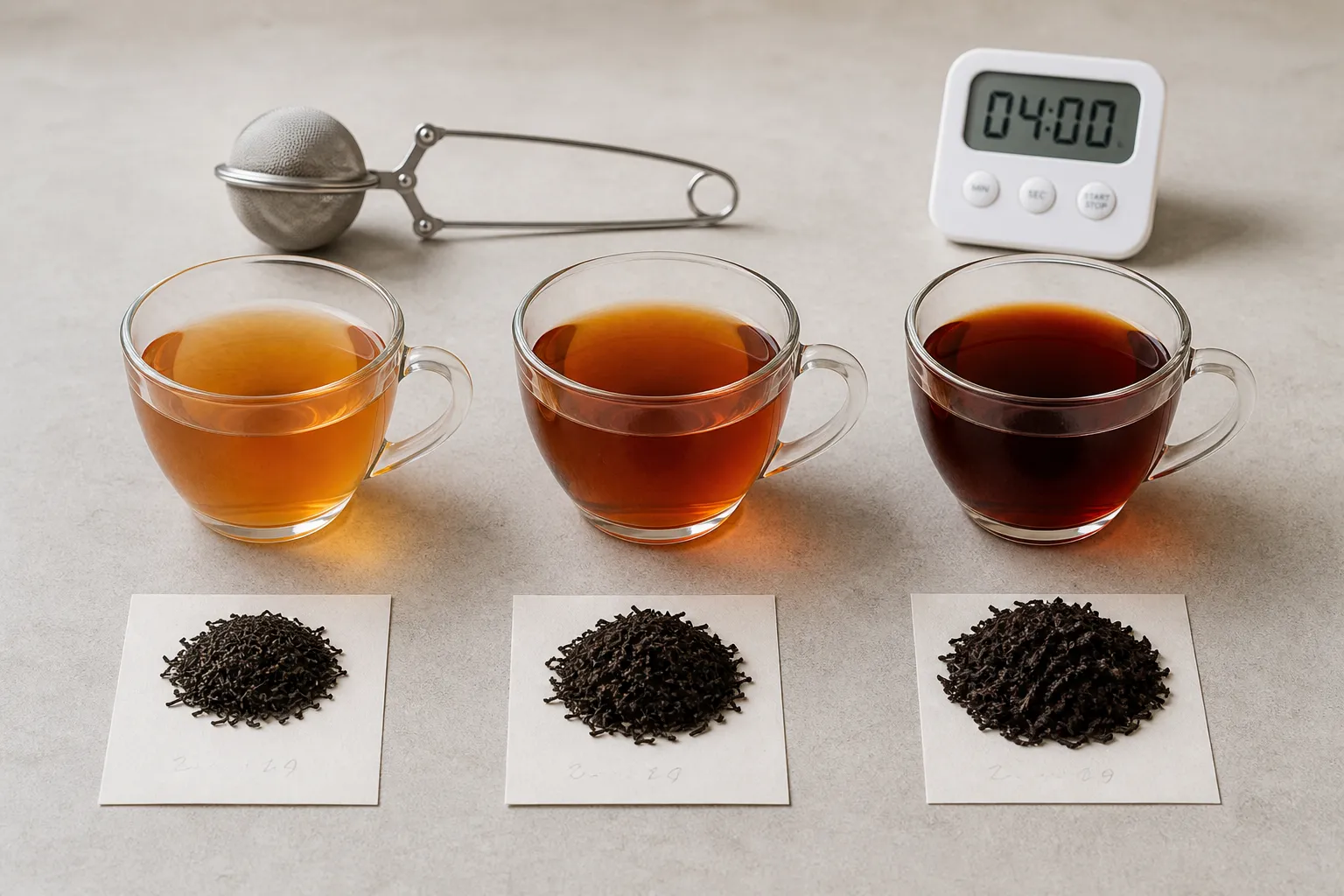
Pick one black tea and one cup. Brew it three times on different days, changing only the leaf amount.
For an 8-ounce mug, try:
2.5 g
Lighter, useful for judging aroma and softness.
3 g
Balanced starting point for many plain cups.
3.5 g
Fuller body, useful for milk or a stronger morning cup.
Keep the steeping time the same for all three trials. Taste for color, aroma, body, briskness, bitterness, and astringency. If 3 grams tastes balanced, make that your house measure for that tea. If 2.5 grams is clearer, use the lighter dose. If 3.5 grams holds up better, mark that on the package or storage tin.
For spoon measuring, do the same exercise visually. Weigh your preferred dose once, place it in your regular teaspoon, and notice whether it is level, rounded, or heaped. That turns an abstract gram target into a daily brewing habit.
A good ratio should make the tea easy to repeat. The cup should taste intentional, not accidental.
The Useful Answer, With Its Limits
Use about 2 grams of loose leaf black tea for 6 ounces of water, or about 3 grams for an 8-ounce mug, then adjust in small steps. Use more leaf for a fuller cup, a larger mug, or milk. Use less leaf, or shorten the steep, when the cup turns bitter, overly drying, or heavier than you want.
The limit is simple: there is no single black tea leaf to water ratio that fits every leaf, mug, and preference. Leaf cut, blend, grade, freshness, water, steeping time, cup size, and taste all change the answer. Start with the baseline, then let the next cup tell you where to move.