Brewing measure
Black Tea Teaspoons vs Grams: Which Measurement Is More Reliable
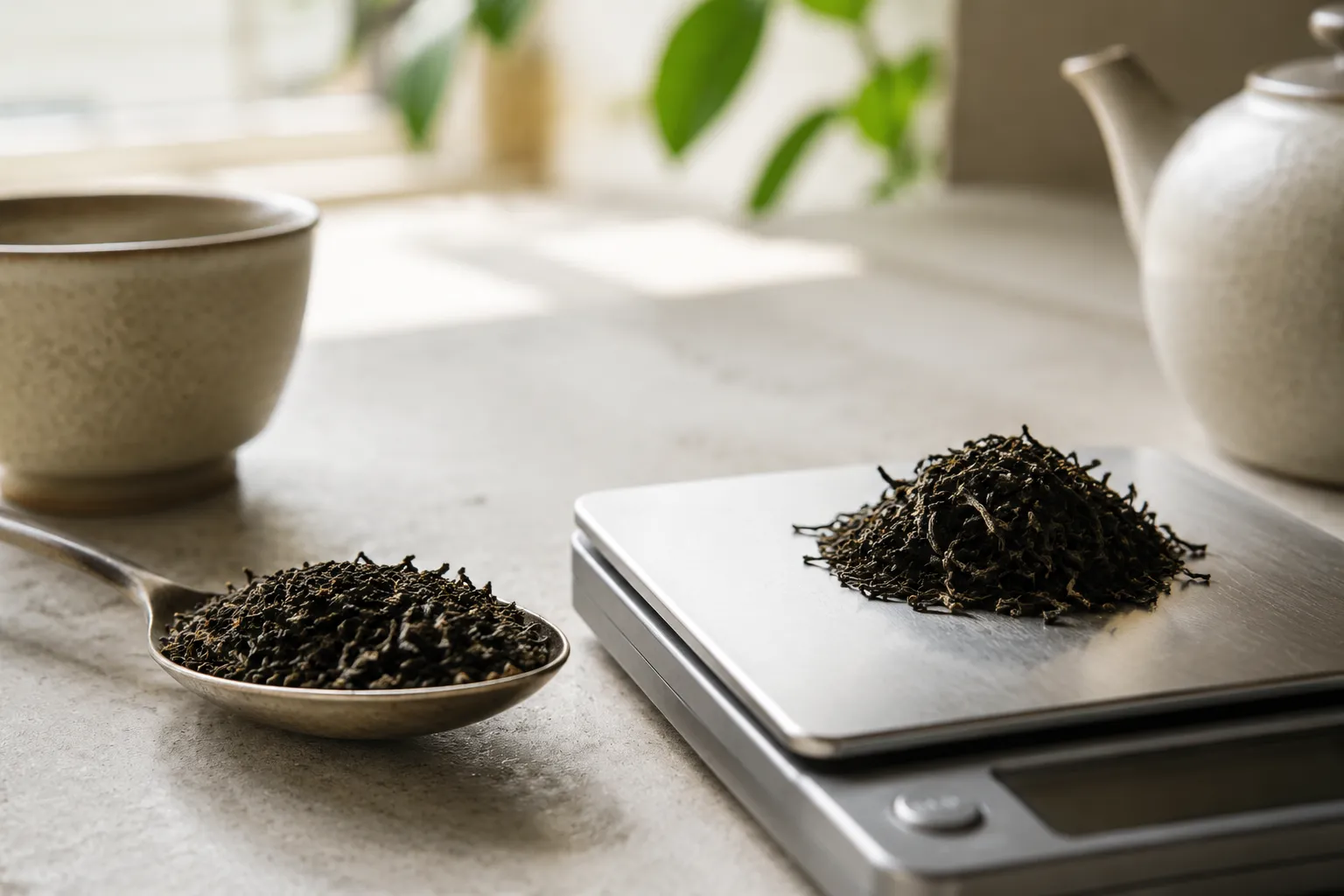
A teaspoon can get you close, but grams are more reliable for black tea when you want the same strength from one cup to the next. A teaspoon measures volume; grams measure mass. Loose black tea does not fill a spoon the same way every time, especially when one tea is long and wiry, another is broken and dense, and another has fine particles that settle into the bowl of the spoon.
For casual brewing, teaspoons of black tea can be good enough if you use the same tea, spoon, cup size, and idea of “level” or “heaping.” For repeatable brewing, comparison, or troubleshooting, black tea teaspoons vs grams is not a close contest: measure black tea by weight.
upward
Start with the broader guide
Use the broader guide first if you need the full scope before this page.
The Practical Answer Beside the Kettle
Use grams when the cup needs to be repeatable. That includes tasting a new black tea, comparing two teas, following a brewing note, scaling one mug into a pot, or working out why a cup tastes thin, harsh, bitter, or too astringent. Weight lets you keep the leaf amount steady while you change only one variable at a time, such as steep time or water volume.
Use a teaspoon when the setting is informal. If you make the same breakfast blend in the same mug every morning, a level teaspoon may be enough. It becomes less reliable when you switch from a dense broken-leaf Assam to a long, twisted Chinese black tea, or when one scoop is level and the next is rounded.
The useful rule is not “one teaspoon always equals a certain number of grams.” A better rule is: choose a starting amount, name the cup size, and keep the method consistent. Many tea instructions use language such as about 2 grams per teaspoon, 2–3 grams per 8 oz cup, or a heaping teaspoon per serving. Treat those as brewing conventions, not fixed conversions for every black tea.
If you want one clean starting point, choose a modest gram dose for your usual 8 oz cup, then adjust by taste. If the liquor is pale and quiet, use a little more leaf or steep slightly longer next time. If the cup is rough, bitter, or drying, reduce the leaf, shorten the steep, or adjust water temperature depending on the tea.
Why a Teaspoon Changes From One Black Tea to Another
Leaf density changes the scoop
The main issue with black tea grams vs volume is leaf density. A spoonful of loose tea is not like a spoonful of fine table salt. The leaf may be long, curled, flat, twisted, broken, rolled, or mixed with smaller pieces. Those shapes change how much air sits between the leaves and how much tea actually lands in the spoon.
Whole, broken, and fine leaf behave differently
A fluffy, whole-leaf black tea can look generous while weighing less than expected. The leaves bridge over one another and create empty space. A broken-leaf tea can pack more tightly into the same spoon. A tea with smaller fragments can settle even more densely, especially if the spoon is dipped into the bottom of a tin or pouch.
Spoon shape adds another difference
A narrow tea spoon, a deep kitchen teaspoon, and a shallow cutlery spoon do not hold the same practical scoop. Even before weight enters the question, “one teaspoon” may mean different things in different kitchens.
Level, rounded, and heaping are not the same
A level teaspoon is scraped or leveled across the top. A rounded teaspoon rises slightly above the rim. A heaping teaspoon of black tea can be much larger, especially with springy leaf that piles high. When people ask how many grams are in a teaspoon, they often mix three ideas: a formal spoon volume, a kitchen spoon, and a personal scoop habit.
That is why grams are more dependable. They do not remove every brewing variable, but they remove one large source of drift: the changing amount of leaf.
Cup Size Changes the Dose Question
A black tea dose by grams only makes sense when the water volume is named. “Per cup” can be vague because tea instructions may refer to 6 oz or 8 oz cups, while many household mugs hold more than either. A teaspoon that tastes balanced in a small cup may seem weak in a larger mug, even if the leaf was measured consistently.
For an 8 oz cup, many common loose-leaf instructions cluster around a small dose, often expressed as teaspoons or a few grams. The exact amount should stay flexible because black tea style, cut, freshness, steep time, and personal strength preference all matter. The important point is to pair the dose with the actual water amount.
If your mug holds 12 oz, do not judge the tea by an 8 oz instruction without adjusting. Either increase the leaf in proportion or accept a lighter cup. If your teapot holds 24 oz, a single teaspoon will not behave like a single-cup recipe. This is where grams help again: scaling three 8 oz servings is easier by weight than by a pile of spoons that may be level, rounded, or uneven.
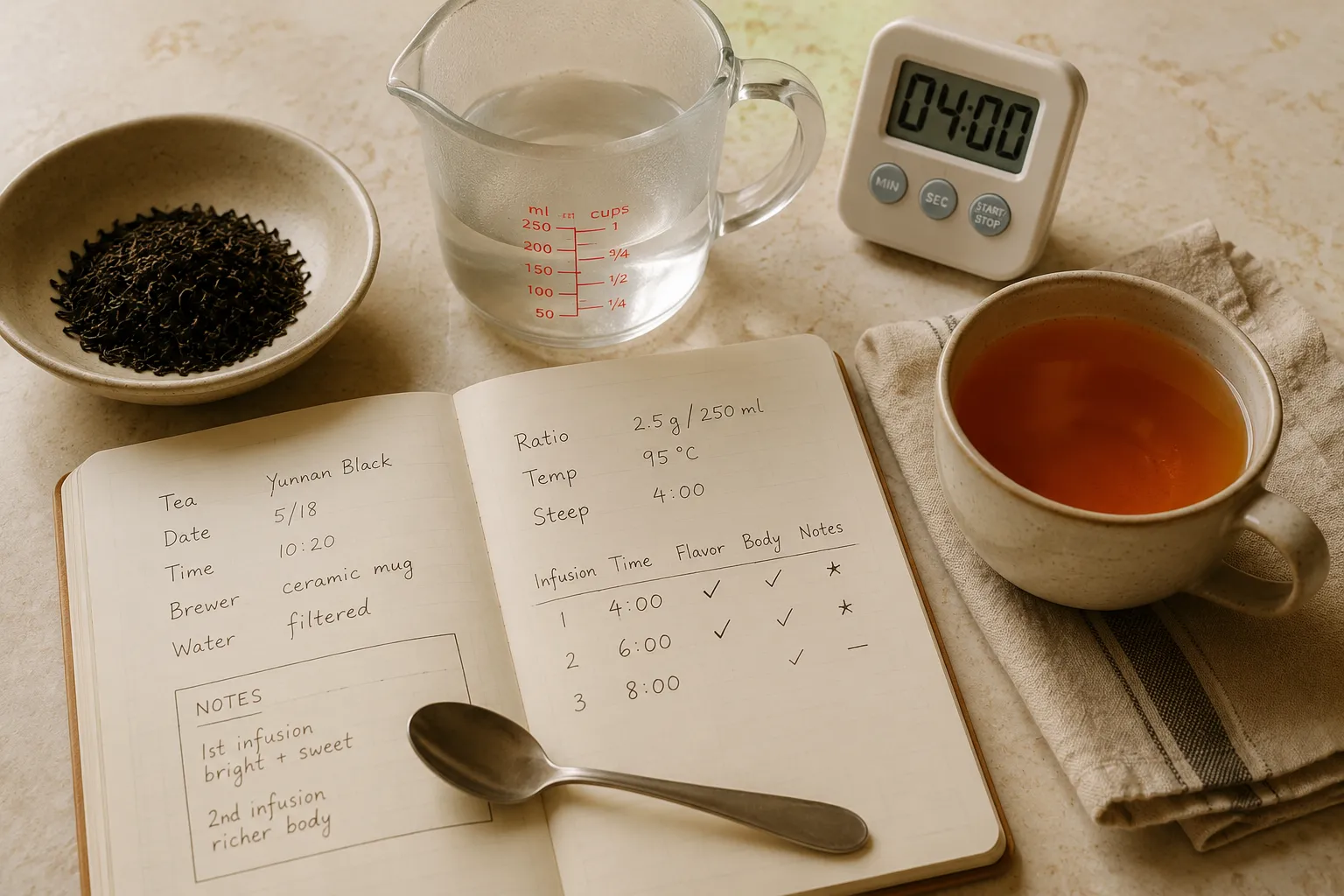
For consistent black tea strength, write the ratio in your own terms: grams of leaf, water volume, steep time, and cup result. A note such as “3 g, 8 oz, 4 minutes, brisk but not harsh” is more useful than “one scoop, tasted fine.”
When Teaspoons Are Good Enough
Teaspoons are not wrong. They are just less controlled. For many drinkers, that is acceptable because black tea is often brewed by habit: same tin, same kettle, same mug, same milk or no milk, same preferred strength.
A teaspoon works best when all of these are true:
- You are using one familiar black tea, not comparing several.
- Your spoon is the same each time.
- You decide whether the spoon is level, rounded, or heaping.
- Your cup size stays consistent.
- You adjust by taste rather than trying to match a precise recipe.
The easiest way to make a teaspoon more reliable is to calibrate it once. Weigh the amount of black tea you like for your usual cup. Then place that same amount into your own spoon and notice what it looks like. Is it a flat level teaspoon, a slightly rounded teaspoon, or closer to two smaller spoonfuls? That visual memory is more useful than a universal conversion.
Calibrating a tea teaspoon is especially helpful if you do not want to weigh tea every morning. You can use grams once to learn your spoon, then brew casually with a clearer sense of what your scoop means. Keep the same water volume and steep time while you adjust; otherwise you will not know which change affected the cup.
When Grams Are Worth the Extra Step
Measure black tea by weight when you want to separate the tea from the method. If a cup turns bitter, it is tempting to blame the leaf. Sometimes the issue is the amount of leaf, a long steep, a small cup, very hot water, or a dense scoop that contained more tea than expected. Weight does not solve every problem, but it makes the first question clearer: how much leaf was actually used?
Grams are especially useful for:
- New teas with unfamiliar leaf shape or density.
- Side-by-side tastings where each cup should be comparable.
- Brewing notes that give a dose by grams.
- Larger teapots, where spoon counts become imprecise.
- Adjusting strength without changing every variable at once.
- Tracking why one cup was brisk and full while another was flat or drying.
This does not require turning daily black tea into a laboratory routine. A small kitchen scale can be a practical brewing tool, but this page is not a scale-buying guide and the available material does not support claims about specific models or advertised precision. The point is repeatability, not ceremony.
If you brew mostly one familiar tea, a calibrated spoon may be enough. If you rotate between whole-leaf, broken-leaf, and finely cut black teas, grams will save confusion.
Common Confusion Around Black Tea Teaspoons vs Grams
A teaspoon is not a fixed weight
A teaspoon is a volume measure. The gram weight inside that volume changes with black tea leaf density, cut, and how the spoon is filled.
Level and heaping are different brewing choices
A level teaspoon and a heaping teaspoon can produce noticeably different liquor strength. If your cup swings between thin and too strong, the spoon may be changing more than the tea.
“Per cup” needs a water volume
A 6 oz cup, an 8 oz cup, and a large mug are different brewing situations. Dose advice that does not name water volume is incomplete.
Dose cannot fix every flavor issue
More leaf can create more body and stronger aroma, but it can also push bitterness or astringency forward if the steep is already long. Less leaf can soften a rough cup, but it may also make the tea taste hollow if the steep time is too short. Dose, time, water temperature, and leaf style work together.
Market language is a starting point, not a controlled measure
Tea packages, product pages, and casual brewing advice often use tidy phrases such as one teaspoon per cup or a few grams per serving. Those phrases can be useful starting points, but they are not controlled measurements across all black teas.
A Simple Way to Choose Your Method
For repeatable black tea
Weigh the leaf. Start with your chosen grams per 8 oz cup, keep the steep time steady, and taste the result. Make one change at a time: a little more leaf for a fuller cup, a little less leaf or a shorter steep for a softer one.
For a relaxed routine
Use a teaspoon, but make it a known teaspoon. Pick one spoon, decide level or rounded, use the same cup, and notice the liquor. A deep reddish-brown cup with clear aroma and the briskness you like tells you more than the spoon alone. A pale cup may need more leaf or time. A harsh, drying cup may need less leaf, less time, or a gentler approach.
The answer is not that teaspoons are useless or that grams are required for every mug. Grams are the more reliable measurement; teaspoons are convenient once they are tied to a specific tea, spoon, and cup. For your next brew, match the method to the job: spoon for a familiar habit, grams for a cup you want to repeat.